Customization at Scale: US Apparel Manufacturing in 2026
Advertisements
By 2026, mass personalization is fundamentally transforming US apparel manufacturing, shifting from mass production to on-demand, customized garments, driven by advanced technology and evolving consumer expectations.
The landscape of the US apparel industry is undergoing a monumental shift, moving away from the traditional model of mass production towards an era defined by individual consumer needs. By 2026, Customization at Scale: How Mass Personalization is Changing US Apparel Manufacturing in 2026 is not just a trend but a foundational pillar, reshaping everything from design to delivery. What does this mean for brands, manufacturers, and, most importantly, consumers?
Advertisements
The rise of individualized fashion in the US
The demand for unique clothing has never been higher. Consumers are increasingly seeking garments that reflect their personal style, fit their specific body types, and align with their values. This desire for individuality is pushing US apparel manufacturers to rethink their entire operational framework.
Mass personalization, in this context, refers to the ability to deliver individually tailored products or services to mass market customers. It’s a delicate balance between the economies of scale that mass production offers and the bespoke experience of custom-made items. Achieving this balance requires significant technological advancements and a paradigm shift in how companies approach their business models.
Shifting consumer expectations
Today’s consumers are digital natives, accustomed to instant gratification and hyper-relevant experiences. They expect apparel to be more than just functional; it must be an extension of their identity. This expectation extends beyond aesthetics to include ethical sourcing, sustainability, and transparency in the supply chain.
- Unique design elements: Shoppers want to choose colors, patterns, and graphics.
- Perfect fit: Standard sizing often falls short, leading to demand for custom measurements.
- Ethical production: A growing segment prioritizes sustainable and fair labor practices.
- Brand connection: Consumers seek brands that offer a sense of co-creation.
The shift towards individualized fashion is not merely a fleeting trend; it represents a fundamental change in consumer behavior that will continue to drive innovation in the US apparel manufacturing sector. Companies that fail to adapt risk losing market share to agile, customer-centric competitors.
Technological drivers of mass personalization
The ability to offer mass personalization at an economically viable scale is heavily reliant on cutting-edge technologies. These innovations are transforming every stage of the apparel manufacturing process, from initial design to final assembly and distribution. Without these technological drivers, the vision of customized clothing for everyone would remain an unattainable dream.
Artificial intelligence, advanced robotics, and sophisticated data analytics are no longer futuristic concepts but integral components of the modern US apparel factory. These tools enable manufacturers to process complex data, automate intricate tasks, and respond to consumer demands with unprecedented speed and accuracy.
Artificial intelligence and machine learning
AI algorithms are revolutionizing design, pattern making, and inventory management. They can analyze vast amounts of consumer data to predict trends, recommend personalized styles, and even generate unique design variations based on individual preferences. This predictive capability significantly reduces waste and optimizes production.
- Predictive analytics: Forecasting demand for specific customizable features.
- Design automation: Generating unique patterns and prints based on user input.
- Fit algorithms: Creating tailored patterns from minimal body measurements.
3D printing and advanced robotics
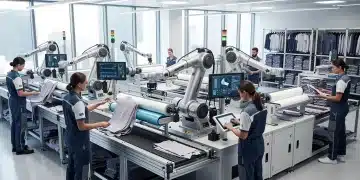
Additive manufacturing, particularly 3D printing, offers unparalleled flexibility in creating intricate components and even entire garments. Robotics, on the other hand, automates repetitive tasks with precision, speeding up production and reducing labor costs, making small-batch and individualized production more feasible.
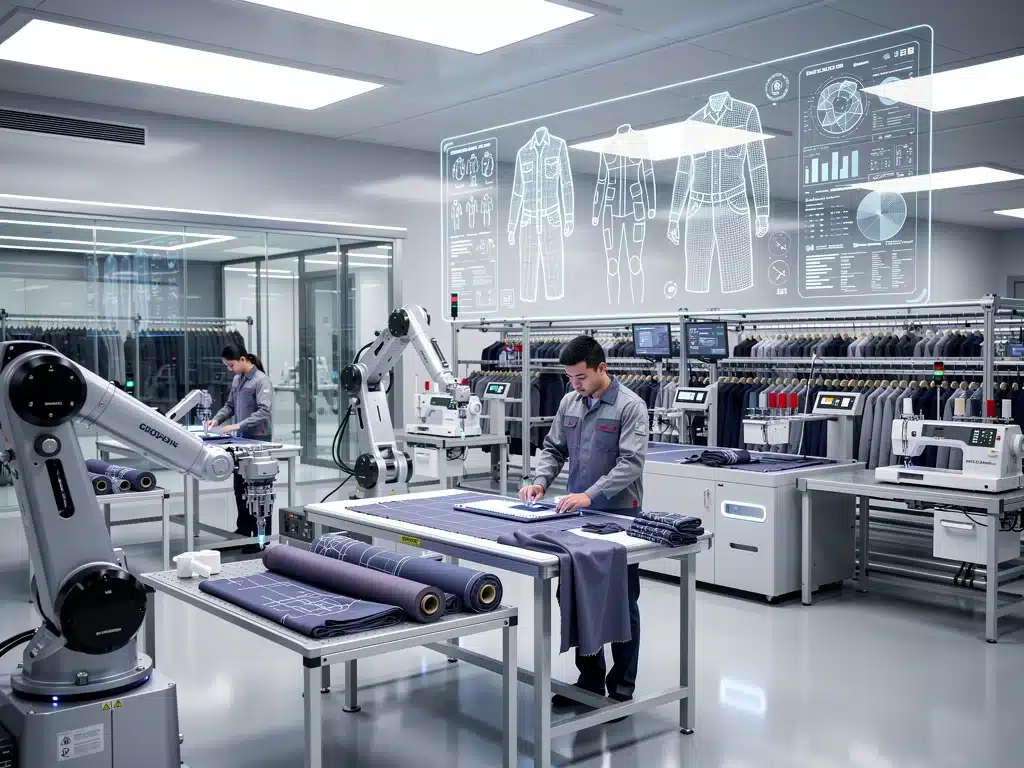
Robotic arms can handle delicate fabrics, perform complex stitching operations, and manage materials efficiently, all while maintaining consistent quality. This automation is crucial for scaling customization without sacrificing craftsmanship or increasing lead times excessively.

Data analytics and digital supply chains
The collection and analysis of consumer data are paramount for effective mass personalization. Digital supply chains, powered by IoT and blockchain, provide real-time visibility into every stage of production, enabling agile responses to changing demands and ensuring transparency.
This data-driven approach allows manufacturers to understand consumer preferences at a granular level, optimize material sourcing, and streamline logistics for individual orders. The result is a highly efficient, responsive, and personalized manufacturing ecosystem.
Impact on US apparel manufacturing processes
The shift to mass personalization is profoundly altering traditional apparel manufacturing processes in the US. Factories are becoming more flexible, agile, and technologically integrated. The linear production lines of the past are being replaced by modular, adaptable systems capable of handling a diverse range of products simultaneously.
This transformation requires significant investment in new machinery, software, and workforce training. Manufacturers must move away from static, large-batch production to dynamic, on-demand systems that can produce one-off items as efficiently as a hundred.
On-demand production and micro-factories
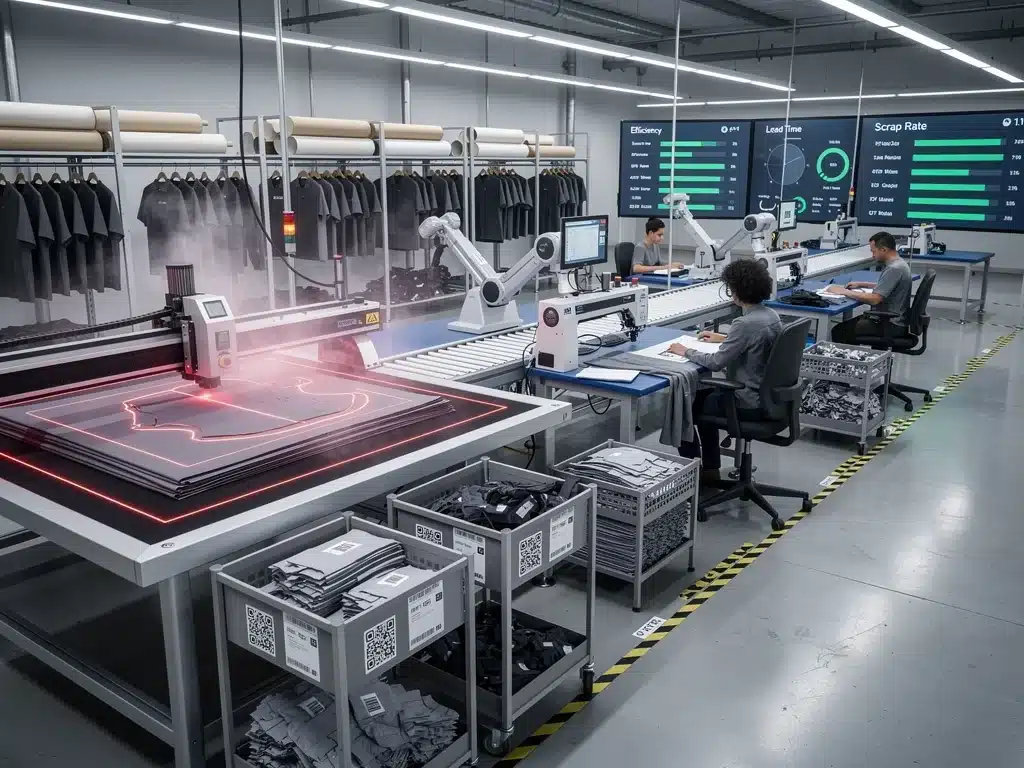
On-demand production minimizes inventory waste and enables rapid response to consumer orders. Micro-factories, smaller and highly automated production units, are emerging as a key solution, allowing for localized manufacturing and faster delivery times.
- Reduced waste: Producing only what is ordered eliminates excess inventory.
- Faster lead times: Localized production means quicker turnaround from order to delivery.
- Increased flexibility: Micro-factories can easily adapt to changing product lines.
These smaller, more versatile manufacturing units are often located closer to consumer markets, further reducing shipping times and environmental impact. They represent a significant departure from the large, centralized factories that once dominated the industry.
Digital design and virtual prototyping
The design phase is now largely digital, utilizing 3D modeling and virtual prototyping. This not only accelerates the design process but also allows consumers to visualize and even co-create their garments in real-time, reducing the need for physical samples and costly iterations.
Virtual try-on technologies using augmented reality are also becoming more prevalent, allowing customers to see how a customized garment would look on them before it’s even produced. This enhances the customer experience and minimizes returns due to fit or aesthetic discrepancies.
Supply chain transformations for customization
For mass personalization to succeed, the entire supply chain must be re-engineered. Traditional linear supply chains, designed for mass production, are too slow and inflexible to accommodate the complexities of individual orders. The new paradigm demands a highly responsive, interconnected, and transparent network.
This involves closer collaboration between designers, material suppliers, manufacturers, and logistics partners. The focus shifts from pushing products to the market to pulling products based on specific consumer demand, often in real-time.
Hyper-localization and nearshoring
To support rapid customization and reduce lead times, there’s a growing trend towards hyper-localization and nearshoring of manufacturing facilities. Producing closer to the consumer market minimizes transit times and enhances responsiveness.
This strategic move also helps mitigate geopolitical risks and supply chain disruptions that have plagued global manufacturing in recent years. By bringing production closer to home, US manufacturers gain greater control and flexibility.
Modular and agile sourcing
Material sourcing needs to be far more agile, with suppliers capable of delivering smaller quantities of diverse materials on demand. The emphasis is on building a network of reliable, flexible suppliers rather than relying on a few large-volume providers.
This modular approach allows manufacturers to quickly switch between different fabrics, trims, and components based on individual customer choices, without holding excessive inventory of every possible option. It’s a just-in-time approach tailored for customization.
Sustainability and ethical implications
Mass personalization, when implemented correctly, holds significant promise for improving sustainability and ethical practices within the US apparel industry. By producing only what is ordered, it drastically reduces overproduction and waste, a major issue in traditional fashion.
However, it also presents new challenges, particularly concerning material sourcing and energy consumption. Manufacturers must ensure that their customizable processes are not merely shifting environmental burdens elsewhere in the supply chain.
Reducing waste through on-demand production
One of the most compelling environmental benefits of mass personalization is the drastic reduction in textile waste. Overproduction is a notorious problem in fashion, with vast quantities of unsold garments ending up in landfills. On-demand manufacturing directly addresses this issue.
- Minimized inventory: No excess stock means less waste.
- Resource efficiency: Production is optimized for specific orders, reducing material offcuts.
- Closed-loop systems: Easier to implement recycling and upcycling with precise production.
Ethical labor and transparency
Localized production, often a byproduct of mass personalization, can lead to improved labor conditions and greater transparency. Shorter supply chains make it easier to monitor working environments and ensure fair wages and practices.
Consumers who prioritize ethical sourcing can verify these practices more readily when production is closer to home and more visible. This fosters trust and enhances brand reputation, aligning with the values of the modern conscientious consumer.
Challenges and opportunities for US manufacturers
While the benefits of mass personalization are clear, US apparel manufacturers face substantial challenges in adopting this model. The transition requires significant capital investment, a skilled workforce, and a willingness to disrupt established business practices. However, overcoming these hurdles unlocks immense opportunities for growth and competitive advantage.
The market for personalized goods is expanding rapidly, and early adopters who can effectively scale customization will capture a significant share. This requires strategic planning, technological prowess, and a deep understanding of evolving consumer needs.
Investment in technology and infrastructure
The upfront cost of integrating AI, robotics, 3D printing, and digital supply chain solutions can be prohibitive for many small and medium-sized manufacturers. Access to capital and government incentives will be crucial for widespread adoption.
Beyond machinery, there’s a need to invest in robust software platforms that can manage complex customization options, track individual orders, and integrate seamlessly with various production stages.
Workforce reskilling and talent acquisition
The shift to advanced manufacturing requires a workforce with new skills, particularly in data science, robotics operation, and digital design. Manufacturers must invest in reskilling their current employees and attracting new talent with specialized expertise.
The traditional roles in apparel manufacturing will evolve, with a greater emphasis on technical proficiency and problem-solving in a highly automated environment. Education and training programs need to adapt to these changing requirements.
Market differentiation and competitive advantage
For those who successfully implement mass personalization, the opportunities are vast. Brands can differentiate themselves by offering unparalleled product uniqueness, superior fit, and a highly engaging customer experience. This can lead to increased customer loyalty and premium pricing.
Furthermore, the ability to respond rapidly to market trends and consumer feedback provides a significant competitive edge, allowing manufacturers to stay ahead in a fast-paced industry.
| Key Aspect | Impact on US Apparel Manufacturing by 2026 |
|---|---|
| Consumer Demand | Driving shift towards unique designs, perfect fit, and ethical production. |
| Technology Integration | AI, robotics, and 3D printing enable scalable customization and efficiency. |
| Supply Chain Evolution | Moving to agile, localized, and transparent networks for faster delivery. |
| Sustainability Focus | Reduces waste and promotes ethical labor through on-demand, local production. |
Frequently asked questions about apparel customization
Mass personalization in apparel manufacturing is the ability to produce unique, custom-fit garments for individual consumers at a scale and cost previously associated with mass production. It combines technological efficiency with individual customer preferences to deliver bespoke clothing solutions efficiently.
By 2026, technologies like artificial intelligence for design and trend prediction, advanced robotics for automated production, 3D printing for unique components, and robust data analytics for supply chain optimization are crucial. These innovations make personalized production economically viable and scalable.
Consumers benefit from perfect-fitting garments, unique styles that reflect their individuality, and products aligned with their ethical and sustainable values. It offers a more engaging and satisfying shopping experience, moving beyond generic offerings to truly personal fashion.
Mass personalization significantly boosts sustainability by enabling on-demand production, which drastically reduces overproduction and textile waste. It also often encourages localized manufacturing, decreasing transportation emissions and fostering greater transparency in labor practices, leading to a more ethical supply chain.
Challenges include substantial initial investment in new technologies, the need for workforce reskilling to operate advanced machinery and software, and the complex task of reconfiguring traditional supply chains. Manufacturers also need to adapt their business models to handle individual orders efficiently.
Conclusion
The transformation of US apparel manufacturing by 2026, driven by mass personalization, signifies a pivotal moment for the industry. This shift, fueled by evolving consumer demands and advanced technological integration, is moving the sector towards a more agile, sustainable, and consumer-centric future. While challenges in investment and workforce adaptation exist, the opportunities for innovation, market differentiation, and ecological responsibility are immense. Manufacturers who embrace these changes will not only meet the demands of the modern consumer but also redefine the very essence of fashion production in the United States.