Advanced Materials in Automotive Manufacturing: 5% Weight Reduction by 2026
Advertisements
Advanced materials in automotive manufacturing are pivotal for achieving a projected 5% vehicle weight reduction by 2026, directly enhancing fuel economy, reducing emissions, and extending electric vehicle range.
The automotive industry is in constant pursuit of innovation, driven by demands for increased efficiency, improved performance, and reduced environmental impact. A key strategy to meet these evolving challenges is lightweighting, and at its core lies the revolutionary use of advanced materials in automotive manufacturing: reducing vehicle weight by 5% in 2026 is not just an ambitious target but a critical benchmark for the industry’s future. This transformation promises to redefine how vehicles are designed, built, and powered, ushering in an era of more sustainable and dynamic transportation.
Advertisements
The imperative for lightweighting in automotive manufacturing
The drive to reduce vehicle weight is more critical than ever. With stringent emission regulations and the rapid expansion of electric vehicles (EVs), every pound saved translates into tangible benefits, from better fuel economy in internal combustion engine (ICE) vehicles to extended range and faster charging times for EVs. This section explores the foundational reasons behind the industry’s relentless pursuit of lighter vehicles.
Automakers face immense pressure to innovate. Consumers demand vehicles that are not only safe and comfortable but also environmentally friendly and economical to operate. Lightweighting addresses these demands head-on, offering a multifaceted solution to complex engineering and market challenges.
Environmental benefits and regulatory compliance
Reducing vehicle weight directly correlates with lower fuel consumption and decreased CO2 emissions. For ICE vehicles, a lighter body means less energy is required to accelerate and maintain speed, leading to better mileage and a smaller carbon footprint. This is crucial for meeting global emission standards.
- Lower CO2 emissions from internal combustion engines.
- Compliance with increasingly strict global environmental regulations.
- Contribution to overall carbon neutrality goals.
Performance enhancements and safety considerations
Beyond environmental gains, lightweighting significantly improves vehicle dynamics. Lighter cars exhibit better acceleration, more responsive handling, and shorter braking distances. While reducing weight, manufacturers must ensure that structural integrity and crashworthiness remain uncompromised, often enhancing safety through smarter material choices and design.
The balance between weight reduction and safety is a delicate one, requiring advanced engineering and rigorous testing. Modern materials are engineered to absorb impact more effectively, distributing forces and protecting occupants even with a lighter structure. This dual focus ensures that performance gains do not come at the expense of passenger well-being.
Economic advantages and electric vehicle range extension
For consumers, improved fuel efficiency translates into lower running costs. For manufacturers, the ability to produce lighter, more efficient vehicles can open new market segments and enhance brand reputation. In the EV sector, lightweighting is particularly transformative, as battery weight is a significant factor. A lighter vehicle can travel further on a single charge, addressing one of the primary concerns for EV adoption: range anxiety.
The economic benefits extend throughout the vehicle’s lifecycle, from reduced material consumption in manufacturing to lower operational costs for the end-user. This holistic approach makes lightweighting an attractive proposition for all stakeholders.
The push for lightweighting is not merely a trend but a fundamental shift in automotive design and engineering. It underpins the industry’s ability to meet future demands for sustainability, performance, and efficiency, setting the stage for the widespread adoption of advanced materials.
The rise of advanced materials: beyond traditional steel
For decades, steel has been the backbone of automotive construction, valued for its strength, affordability, and ease of manufacturing. However, the ambitious goal of a 5% vehicle weight reduction by 2026 necessitates a shift towards materials with superior strength-to-weight ratios. This section delves into the innovative materials now taking center stage in automotive manufacturing.
The material science landscape has evolved dramatically, offering engineers a palette of options that were once considered exotic or cost-prohibitive. These advanced materials are not just lighter; they often possess enhanced properties that contribute to overall vehicle performance and safety.
High-strength steels (HSS) and advanced high-strength steels (AHSS)
While moving beyond traditional steel, advancements in steel metallurgy have led to the development of HSS and AHSS. These steels offer significantly higher strength with thinner gauges, allowing for weight reduction while maintaining or even improving structural integrity. They are a cost-effective lightweighting solution that can be integrated into existing manufacturing processes.
The continuous innovation in steel alloys means that steel remains a relevant and evolving material in the lightweighting conversation, providing a bridge between conventional methods and more radical material substitutions.
Aluminum alloys: a proven lightweighting solution
Aluminum has long been recognized for its lightweight properties and corrosion resistance. Its increased use in body structures, engine blocks, and suspension components has already contributed significantly to weight reduction across various vehicle segments. The challenge with aluminum lies in its cost and specific manufacturing requirements, such as specialized welding techniques.
- Excellent strength-to-weight ratio.
- Superior corrosion resistance.
- Recyclability, contributing to sustainability goals.
Carbon fiber reinforced polymers (CFRPs): the ultimate lightweight material
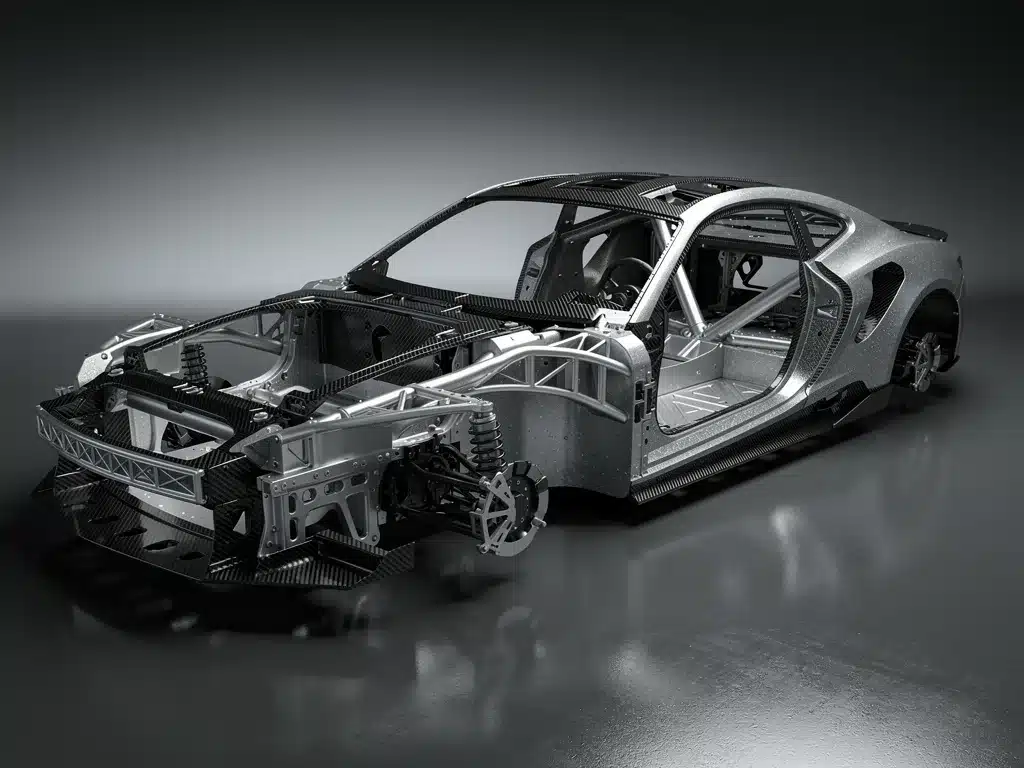
Often dubbed the ‘black magic’ of lightweighting, carbon fiber composites offer unparalleled strength and stiffness at a fraction of the weight of steel. While currently more expensive and complex to manufacture, CFRPs are increasingly being used in high-performance vehicles and structural components where maximum weight savings are paramount. Their application is expected to expand as production costs decrease and manufacturing processes become more efficient.
The aesthetic appeal of exposed carbon fiber also adds to its desirability in premium and sports car segments, further driving its adoption. As manufacturing techniques improve, the use of CFRPs will become more widespread.


Magnesium alloys and other exotic materials
Magnesium is even lighter than aluminum and offers excellent damping properties, making it ideal for certain components like steering wheels, seat frames, and gearbox casings. However, its reactivity and lower ductility present manufacturing challenges. Research continues into other exotic materials and hybrid solutions, combining the best properties of different elements to achieve optimal weight and performance.
The exploration of new material combinations and advanced manufacturing techniques is a continuous process, pushing the boundaries of what is possible in automotive design. The goal of a 5% weight reduction by 2026 relies heavily on the successful integration of these diverse materials.
Manufacturing innovations: shaping the future of lightweight vehicles
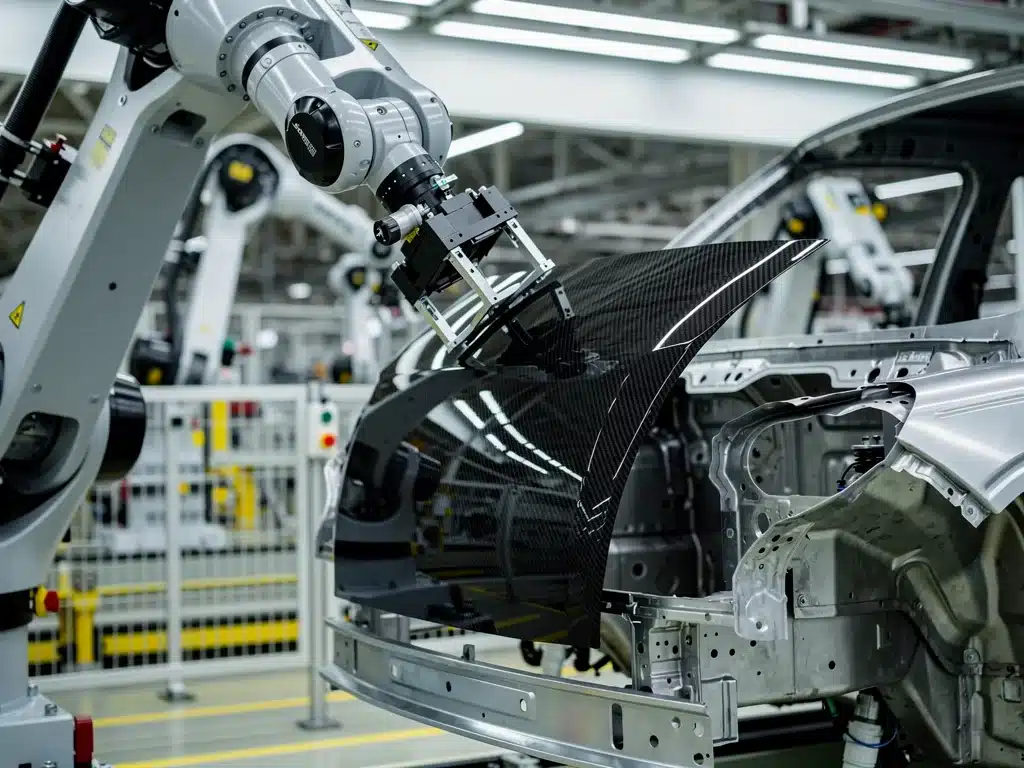
The introduction of advanced materials into automotive manufacturing is not merely about material substitution; it necessitates a revolution in manufacturing processes. Traditional assembly lines, designed for steel, are being re-engineered to accommodate the unique properties and demands of materials like aluminum, carbon fiber, and composites. This section explores the manufacturing innovations driving the lightweighting agenda.
Integrating new materials requires significant investment in research, development, and new production technologies. The goal is to make the use of these advanced materials scalable and cost-effective, ensuring that lightweighting benefits can be realized across a wider range of vehicles.
Advanced joining techniques
Welding, riveting, and bonding methods that work effectively for steel often fall short when dealing with dissimilar materials or those with unique thermal properties. New joining techniques are essential to create strong, durable, and lightweight structures. These include advanced adhesive bonding, laser welding for aluminum, and hybrid joining methods that combine different approaches.
- Friction stir welding for aluminum structures.
- Advanced adhesive bonding for multi-material joints.
- Self-piercing rivets for joining dissimilar metals.
Additive manufacturing (3D printing) for lightweight components
Additive manufacturing, or 3D printing, offers unprecedented design freedom, allowing engineers to create complex geometries that are impossible with traditional manufacturing. This capability is particularly beneficial for lightweighting, as it enables the optimization of component structures to use the minimum amount of material while maintaining strength. It’s also ideal for prototyping and producing specialized, low-volume parts.
The ability to print intricate lattice structures and hollow components opens new avenues for weight reduction without compromising performance. As the technology matures, it is expected to play a larger role in mainstream production.
High-pressure die casting for aluminum and magnesium
High-pressure die casting is a key process for producing complex aluminum and magnesium components with high precision and excellent surface finish. This method allows for the creation of intricate designs that integrate multiple functions into a single part, reducing the need for assembly and further contributing to weight savings. It’s especially effective for structural components and engine parts.
The advancements in die-casting technology have made it possible to produce larger, more complex parts, expanding the applicability of these lightweight metals in automotive design. This continuous refinement of manufacturing processes is vital for meeting the 2026 weight reduction targets.
The synergy between new materials and innovative manufacturing processes is what truly defines the current era of automotive lightweighting. Without these advancements, the ambitious goals for weight reduction would remain out of reach, underscoring the importance of ongoing research and development in this field.
Strategic design and engineering for optimal weight reduction
Achieving a 5% vehicle weight reduction by 2026 is not solely about material selection or manufacturing processes; it also demands a fundamental rethinking of vehicle design and engineering. Strategic design, coupled with advanced simulation and optimization tools, allows engineers to maximize the benefits of lightweight materials while ensuring safety, performance, and cost-effectiveness. This section explores the critical role of design and engineering in the lightweighting journey.
The holistic integration of materials, manufacturing, and design principles is paramount. Every component, from the smallest bracket to the largest body panel, is scrutinized for its weight-saving potential without compromising its intended function or the overall vehicle’s integrity.
Topology optimization and generative design
Topology optimization is a computational design method that determines the optimal material distribution within a given design space for a set of loads and boundary conditions. This results in highly efficient, often organic-looking structures that use the absolute minimum amount of material necessary. Generative design takes this a step further, with AI algorithms exploring thousands of design iterations to find the most efficient solution.
- Minimizing material usage while maintaining structural integrity.
- Creating innovative, lightweight component geometries.
- Accelerating the design and development cycle.
Multi-material architectures and hybrid structures
Instead of relying on a single material, modern vehicle designs increasingly employ multi-material architectures. This involves strategically placing different materials—like steel, aluminum, and composites—in specific areas of the vehicle where their properties are best utilized. For example, high-strength steel might be used in crash zones, while aluminum is preferred for body panels, and carbon fiber for structural reinforcements.
Hybrid structures, combining different materials within a single component, also contribute to this approach. This meticulous material placement optimizes weight, cost, and performance, ensuring that each part serves its purpose with maximum efficiency.
Component integration and functional consolidation
Another effective design strategy is to integrate multiple functions into a single component, reducing the total number of parts and simplifying assembly. For instance, a structural component might also serve as a mounting point for other systems, or a body panel could incorporate aerodynamic features. This consolidation not only saves weight but also reduces manufacturing complexity and potential failure points.
By streamlining the design and reducing part count, engineers can achieve significant weight savings. This approach requires a deep understanding of component interactions and a willingness to challenge conventional design paradigms.
The convergence of advanced design tools and a comprehensive understanding of material properties is enabling engineers to push the boundaries of lightweight automotive design. These strategic approaches are fundamental to realizing the ambitious weight reduction targets set for 2026.
The economic and environmental impact of lightweight vehicles
The transition to lightweight vehicles, driven by advanced materials and innovative manufacturing, carries profound economic and environmental implications. Beyond the immediate benefits of improved fuel efficiency and reduced emissions, this shift is reshaping supply chains, fostering new industries, and contributing to a more sustainable automotive ecosystem. Understanding these broader impacts is crucial for appreciating the significance of the 5% weight reduction target by 2026.
The ripple effects of lightweighting extend far beyond the vehicle itself, influencing everything from the cost of raw materials to the end-of-life recycling processes. This comprehensive impact makes lightweighting a central pillar of future automotive strategy.
Reduced operating costs for consumers
For the average consumer, a lighter vehicle translates directly into lower operating costs. Improved fuel efficiency for ICE vehicles means less money spent at the pump. For electric vehicles, extended range reduces the frequency of charging and can alleviate range anxiety, making EVs more appealing and practical for a wider audience. These savings contribute to the overall affordability and attractiveness of lightweight vehicles.
The long-term economic benefits reinforce the value proposition of investing in advanced materials and lightweight design. This consumer-centric advantage is a powerful driver for industry adoption.
Environmental sustainability and resource efficiency
The environmental benefits are multifaceted. Lower fuel consumption and reduced emissions contribute to cleaner air and mitigate climate change. Furthermore, the focus on advanced materials often involves developing materials that are more easily recyclable or produced with a lower carbon footprint. The entire lifecycle of the vehicle, from material extraction to end-of-life disposal, is becoming more resource-efficient.
This commitment to sustainability is not just about meeting regulations but also about corporate responsibility and responding to growing consumer demand for eco-friendly products. Lightweighting is a key enabler of this broader environmental agenda.

Supply chain transformation and new industry opportunities
The shift to advanced materials is driving significant changes across the automotive supply chain. New material suppliers, specialized manufacturing equipment providers, and skilled labor for handling and processing these materials are emerging. This creates new economic opportunities and fosters innovation in related industries, from material science to advanced robotics.
Establishing robust supply chains for new materials is a complex undertaking, requiring collaboration between automakers, material producers, and technology developers. This transformation is a testament to the industry’s adaptability and commitment to future-proofing its operations.
The economic and environmental impacts of lightweight vehicles are undeniably positive, creating a virtuous cycle of innovation, efficiency, and sustainability. The 5% weight reduction target by 2026 is a milestone in this ongoing journey towards a greener and more efficient automotive future.
Challenges and future outlook for lightweighting
While the benefits of advanced materials in automotive manufacturing are clear, the path to achieving a 5% vehicle weight reduction by 2026 is not without its challenges. Overcoming these hurdles requires continued innovation, strategic investments, and collaborative efforts across the industry. This section addresses the primary obstacles and outlines the future trajectory of automotive lightweighting.
The complexity of integrating new materials and processes, coupled with economic pressures, demands a careful balance of ambition and pragmatism. The industry must navigate these complexities to unlock the full potential of lightweight design.
Cost implications of advanced materials
One of the most significant barriers to widespread adoption of advanced materials like carbon fiber composites is their higher cost compared to traditional steel. While prices are gradually decreasing due to economies of scale and improved manufacturing processes, they still represent a substantial investment for automakers. Finding cost-effective ways to produce and integrate these materials is crucial for broader market penetration.
- High raw material costs for composites and specialized alloys.
- Increased manufacturing complexity and equipment investment.
- Need for new recycling infrastructures for complex material blends.
Manufacturing complexity and scalability
The manufacturing processes for advanced materials are often more complex and time-consuming than those for steel. This can affect production rates and overall scalability. Developing faster, more efficient, and automated manufacturing techniques is essential to meet the high-volume demands of the automotive industry. Research into rapid curing composites and advanced automated assembly is ongoing.
The need for specialized tooling, skilled labor, and stringent quality control adds layers of complexity to the production process. Simplifying these aspects is a key focus for future development.
Repairability and recycling challenges
Repairing vehicles made with multi-material architectures can be more challenging and expensive than traditional steel vehicles, requiring specialized tools and expertise. Similarly, recycling complex combinations of materials, especially composites, presents a significant hurdle. Developing efficient and sustainable recycling processes for advanced materials is vital for closing the loop on their lifecycle and minimizing environmental impact.
Addressing these challenges proactively, through standardized repair procedures and innovative recycling technologies, will be critical for the long-term viability and sustainability of lightweight vehicles.
Despite these challenges, the future of automotive lightweighting remains bright. Continuous research into new materials, advanced manufacturing techniques, and intelligent design will drive further weight reductions beyond 2026. The industry’s commitment to efficiency and sustainability ensures that the pursuit of lighter vehicles will continue to define its trajectory for decades to come.
Looking beyond 2026: the next frontier in lightweighting
The 5% vehicle weight reduction target by 2026 is an important milestone, but it represents just one step in the ongoing evolution of automotive lightweighting. As the industry continues to innovate, new frontiers are emerging, promising even greater efficiencies and more sustainable solutions. This section casts an eye towards the future, exploring what lies beyond the immediate goals and how lightweighting will continue to shape the vehicles of tomorrow.
The relentless pursuit of efficiency and performance, coupled with a growing emphasis on environmental responsibility, ensures that lightweighting will remain a central theme in automotive research and development for the foreseeable future.
Smart materials and self-healing composites
Imagine materials that can adapt their properties in real time or even repair themselves. Research into smart materials, which can change stiffness or shape in response to external stimuli, could lead to dynamic structures that optimize performance under varying conditions. Self-healing composites, capable of autonomously repairing minor damage, would enhance durability and extend component lifespan, further reducing maintenance and replacement costs.
- Materials that actively respond to environmental changes.
- Composites capable of intrinsic damage repair.
- Increased longevity and reduced waste from vehicle components.
Bio-based and sustainable materials
The automotive industry is increasingly exploring bio-based and sustainable materials to reduce its reliance on fossil fuels and minimize its environmental footprint. Materials derived from natural fibers, plant-based resins, and recycled plastics offer promising avenues for lightweighting with a reduced ecological impact. These materials are often lightweight and can be engineered to meet specific performance requirements, aligning with both weight reduction and sustainability goals.
The development of these eco-friendly alternatives is crucial for achieving a truly circular economy in automotive manufacturing. As these materials mature, their integration will become more widespread, offering both weight savings and a greener profile.
Integrated structural batteries and energy harvesting
A revolutionary concept involves structural batteries, where the vehicle’s body panels and chassis components are designed to also store electrical energy. This integration eliminates the need for separate, heavy battery packs, offering significant weight savings and maximizing interior space. Coupled with energy harvesting technologies, which capture and convert ambient energy (e.g., solar, vibrational) into electricity, vehicles could become even more self-sufficient and efficient.
This holistic approach to design, where components serve multiple functions, represents the ultimate lightweighting strategy. By combining structural integrity with energy storage, the future of automotive design could be fundamentally transformed, moving beyond incremental weight reductions to truly integrated and efficient systems.
The journey of automotive lightweighting is a continuous one, fueled by innovation and a vision for a more efficient and sustainable future. The targets set for 2026 are merely stepping stones towards a landscape where vehicles are not only lighter but also smarter, greener, and more seamlessly integrated with their environment.
| Key Aspect | Brief Description |
|---|---|
| Weight Reduction Goal | Automotive industry targets a 5% vehicle weight reduction by 2026. |
| Key Materials | High-strength steels, aluminum alloys, carbon fiber composites, and magnesium alloys. |
| Manufacturing Innovations | Advanced joining, additive manufacturing, and high-pressure die casting for new materials. |
| Impacts | Improved fuel efficiency, extended EV range, lower emissions, and enhanced performance. |
Frequently asked questions about advanced materials and lightweighting
Vehicle weight reduction is crucial for several reasons. It directly improves fuel efficiency and reduces CO2 emissions for internal combustion engine vehicles, helps extend the range of electric vehicles, and enhances overall vehicle performance and handling. This makes cars more economical and environmentally friendly.
Key advanced materials include high-strength steels (HSS), advanced high-strength steels (AHSS), aluminum alloys, carbon fiber reinforced polymers (CFRPs), and magnesium alloys. These materials offer superior strength-to-weight ratios compared to traditional steel, enabling significant weight savings in vehicle structures.
Manufacturing adapts through innovations like advanced joining techniques (e.g., friction stir welding, adhesive bonding), additive manufacturing (3D printing) for complex parts, and high-pressure die casting for aluminum and magnesium. These processes are essential for efficiently integrating diverse materials into vehicle designs.
Key challenges include the higher cost of advanced materials, the complexity and scalability of new manufacturing processes, and difficulties in repairing and recycling multi-material structures. Overcoming these requires ongoing research, investment, and cross-industry collaboration to find sustainable solutions.
Beyond 2026, lightweighting will continue to evolve with smart materials, self-healing composites, bio-based materials, and integrated structural batteries. The goal is to create even more efficient, sustainable, and intelligent vehicles that optimize both performance and environmental impact throughout their lifecycle.
Conclusion
The automotive industry’s commitment to advanced materials in automotive manufacturing: reducing vehicle weight by 5% in 2026 is a testament to its relentless pursuit of innovation and sustainability. This ambitious goal, driven by regulatory pressures, consumer demands, and technological advancements, is fundamentally reshaping how vehicles are conceived, designed, and produced. From the strategic integration of high-strength steels and lightweight aluminum to the revolutionary applications of carbon fiber and magnesium, the material landscape is undergoing a profound transformation. These material innovations are inextricably linked with parallel advancements in manufacturing, such as additive manufacturing and advanced joining techniques, which enable the efficient and cost-effective production of lighter vehicles. While challenges related to cost, complexity, and recyclability persist, the long-term benefits—including enhanced fuel efficiency, extended EV range, reduced emissions, and superior performance—far outweigh the hurdles. As the industry looks beyond 2026, the ongoing exploration of smart materials, bio-based solutions, and integrated structural components promises an even more exciting and sustainable future for automotive transportation. The journey towards a lighter, more efficient vehicle fleet is not just about meeting targets; it’s about pioneering a new era of mobility that benefits both consumers and the planet.