Identifying Rare Scale Models: 4 Key Indicators for 2026
Advertisements
Discover the essential strategies for identifying rare scale models in 2026. This guide details the four crucial indicators that signify a high-value find, empowering collectors to make informed decisions and enrich their collections.
For enthusiasts and seasoned collectors alike, the thrill of discovering a hidden gem among countless miniatures is unparalleled. In 2026, understanding how to pinpoint a truly valuable piece is more crucial than ever, as the market for collectible scale models continues to evolve. This article will guide you through the process of Identifying Rare Scale Models: 4 Key Indicators of a High-Value Find in 2026, ensuring your next acquisition is a significant one.
Advertisements
Understanding the Collectible Scale Model Market in 2026
The landscape of collectible scale models has undergone significant transformations, with certain trends and factors shaping what constitutes a ‘rare’ and ‘high-value’ item in 2026. Beyond mere aesthetics, collectors are increasingly looking for pieces that offer both historical significance and potential for appreciation. This dynamic market demands a keen eye and an understanding of specific indicators that differentiate a common model from a true treasure.
The digital age has also played a pivotal role in democratizing access to information, making it easier to research and verify the provenance of models. However, this also means that competition for genuinely rare items is fiercer. Staying ahead requires not just passion, but also a strategic approach to identification and acquisition.
The Rise of Niche Collectibles
While mainstream models always have a market, 2026 shows a clear trend towards niche and highly specialized scale models. These often include:
- Models of obscure or short-lived vehicle manufacturers.
- Prototypes or concept cars that never went into mass production.
- Vehicles with significant racing history or cultural impact.
These niche markets, while smaller, often yield higher returns for truly rare pieces due to limited production runs and dedicated fan bases. Collectors in these areas are often willing to pay a premium for models that complete their specialized themes.
Technological Advancements in Model Production
Modern manufacturing techniques, including 3D printing and advanced resin casting, allow for unprecedented levels of detail and accuracy. While this has elevated the quality of new models, it also means that older, hand-assembled models with unique imperfections can sometimes command higher values due to their artisanal nature and historical context. The contrast between old and new production methods creates distinct categories of rarity.
In conclusion, the 2026 market for collectible scale models is vibrant and complex. Successful identification of rare items hinges on recognizing market trends, understanding production nuances, and appreciating the historical and cultural significance of each piece. This foundational understanding sets the stage for delving into the specific indicators of high-value finds.
Indicator 1: Limited Production Runs and Scarcity
One of the most fundamental principles driving the value of any collectible is scarcity, and rare scale models are no exception. A model produced in extremely limited quantities immediately gains an intrinsic value that mass-produced items simply cannot match. In 2026, discerning true scarcity requires more than just checking a production number; it involves understanding the context of that production.
Limited production runs can stem from various factors, including licensing agreements, promotional tie-ins, or simply a manufacturer’s decision to create an exclusive item. The lower the number of units made, the harder it becomes to acquire, thus increasing its desirability and market price.
Understanding Production Codes and Series
Many manufacturers provide clues about a model’s rarity through serial numbers, production codes, or specific series designations. It is crucial for collectors to:
- Research manufacturer databases for production figures.
- Look for ‘limited edition’ or ‘special edition’ markings.
- Understand regional releases, as some models were only available in specific markets.
These details, often found on the model’s base, packaging, or accompanying certificates, are vital for authenticating its scarcity. Without such documentation, verifying a model’s limited run can be challenging but not impossible.
The Impact of ‘Chase’ and Promotional Editions
‘Chase’ editions, which are intentionally rare variants released within a larger production run, continue to be highly sought after. Similarly, models produced for specific events, anniversaries, or as promotional items for automotive manufacturers often have extremely low production numbers. These items are frequently distributed through non-retail channels, making them inherently harder to find years later.
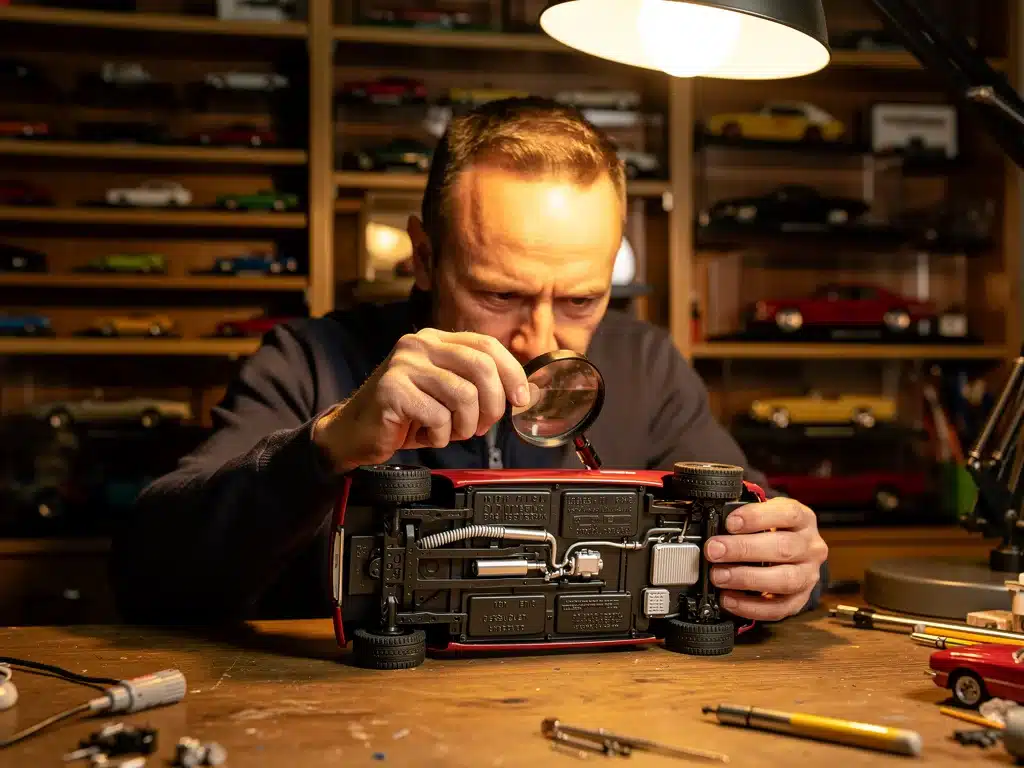
The absence of these models from typical retail channels contributes significantly to their scarcity. A model given as a gift to factory employees, for example, will almost certainly be rarer than one sold globally. Therefore, researching the specific release circumstances of a model is as important as knowing its production number.
In essence, the first key indicator of a high-value find in 2026 is verifiable scarcity. This is often communicated through explicit production numbers or inferred from the unique circumstances of its release. Collectors must become adept at researching these details to accurately assess a model’s rarity and potential value.
Indicator 2: Pristine Condition and Original Packaging (NIB)
For any collectible, condition is paramount, and rare scale models are no exception. A model in pristine condition, ideally still in its original, unopened packaging (often referred to as ‘New In Box’ or NIB), will command a significantly higher price than a damaged or unboxed equivalent. This factor alone can multiply a model’s value several times over, making it a critical consideration for any potential high-value find.
The concept of ‘pristine’ extends beyond just the model itself. It encompasses the integrity of all original components, including mirrors, antennas, and any accessories that came with the model. Any missing or broken parts drastically reduce its appeal and value to serious collectors.
Assessing the Model’s Condition
When evaluating a model’s condition, several aspects must be scrutinized:
- Paintwork: Look for chips, scratches, fading, or ‘paint rash’ (a common issue with older diecast models).
- Decals/Tampos: Ensure they are intact, unfaded, and not peeling.
- Moving Parts: Check that wheels roll freely, steering mechanisms work (if applicable), and doors/hoods open smoothly without resistance or damage.
- Glass/Windows: Must be clear, scratch-free, and securely attached.
Even minor imperfections can detract from a model’s value. Collectors are often seeking an item that looks as if it just left the factory, making meticulous inspection essential.
The Importance of Original Packaging
Original packaging serves multiple purposes: it protects the model, provides context (like production details or series information), and acts as a certificate of authenticity in itself. For a model to be truly high-value, especially if it’s rare, its packaging should be:
- Intact: No tears, creases, or significant wear.
- Clean: Free from dust, dirt, or stains.
- Complete: All inserts, protective films, and tie-downs should be present.
A model that has never been removed from its original packaging (NIB) is the holy grail for many collectors, as it guarantees the model’s condition and preserves its original state. The packaging itself can sometimes be as valuable as the model, especially for vintage items.
In summary, the second critical indicator for a high-value rare scale model in 2026 is its condition, with an emphasis on pristine quality and the presence of original, undamaged packaging. This combination assures collectors of the item’s integrity and enhances its market desirability.
Indicator 3: Manufacturer Reputation and Historical Significance
The origin and lineage of a scale model play a significant role in determining its rarity and value. Models produced by highly reputable manufacturers, especially those with a long history of quality and attention to detail, often command higher prices. Furthermore, models that represent vehicles with significant historical or cultural importance tend to appreciate more over time, regardless of their initial production numbers.
In 2026, collectors are increasingly discerning about the craftsmanship and authenticity associated with certain brands. A model from a renowned maker often implies superior materials, accurate detailing, and a commitment to historical fidelity, all of which contribute to its collectible appeal.
Prestigious Manufacturers and Their Legacy
Brands like BBR, Exoto, CMC, and older Dinky Toys or Corgi models are often associated with exceptional quality and historical significance. When identifying rare scale models, consider the manufacturer’s reputation for:
- Accuracy: How closely does the model replicate the real vehicle?
- Detailing: The intricacy of engines, interiors, and exterior features.
- Material Quality: Use of high-grade diecast, resin, or photo-etched parts.
Models from these manufacturers, particularly their early or limited-run offerings, are frequently among the most valuable in the market. Their legacy provides a baseline of quality and desirability that lesser-known brands may lack.
Models of Historically Significant Vehicles
Beyond the manufacturer, the subject matter of the model itself is a crucial indicator of value. Models representing vehicles that:
- Won iconic races (e.g., Le Mans, Formula 1 championships).
- Were revolutionary in automotive design or engineering.
- Played a role in major historical events or popular culture (e.g., movie cars).
These models often transcend the typical collector’s market and appeal to a broader audience interested in history, pop culture, or motorsport. Their inherent storytelling capability adds an extra layer of value and desirability.
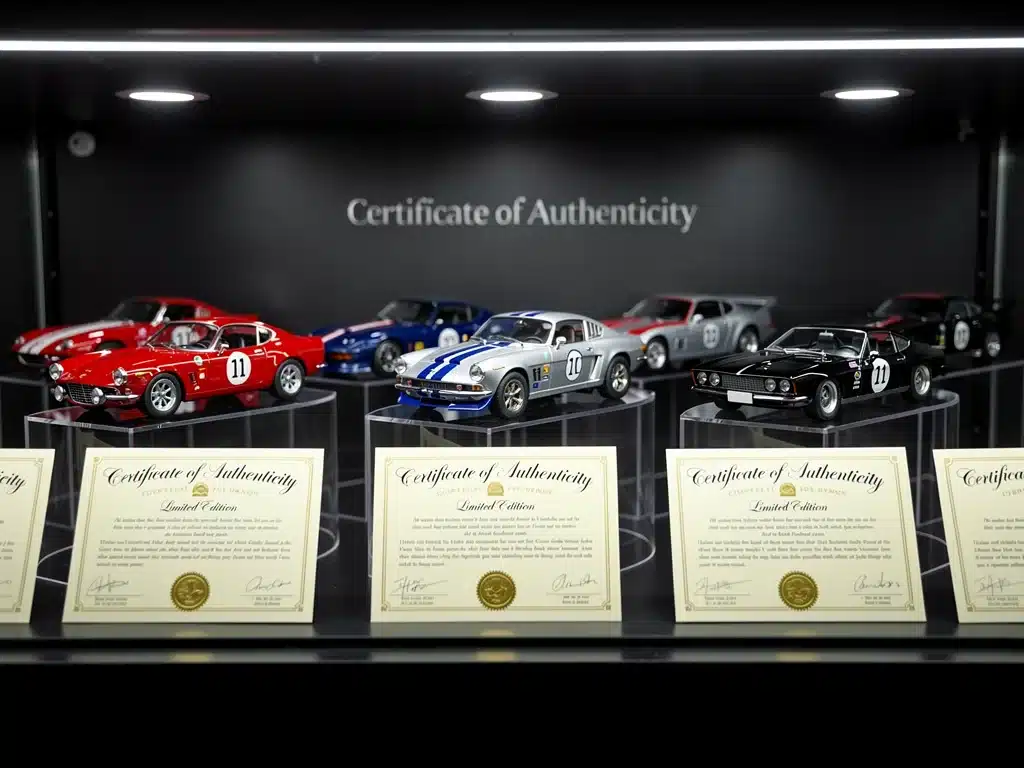
The combination of a prestigious manufacturer and a historically significant vehicle creates a powerful synergy that drives up a model’s rarity and value. This indicator emphasizes that a high-value find is not just about physical attributes but also about the narrative and heritage embedded within the model.
Indicator 4: Provenance and Documentation (Certificates of Authenticity)
In the world of high-value collectibles, the story behind an item, known as its provenance, is often as important as the item itself. For rare scale models in 2026, solid provenance, supported by robust documentation such as certificates of authenticity (COAs), significantly enhances a model’s credibility, rarity, and ultimately, its market value. Without verifiable proof of origin or limited edition status, even a seemingly rare model might struggle to realize its full potential price.
Documentation provides a tangible link to a model’s history, verifying its authenticity, production run, and even its ownership lineage. This is particularly crucial for models from smaller manufacturers or those with very limited releases where public information might be scarce.
The Role of Certificates of Authenticity (COAs)
A Certificate of Authenticity is perhaps the most vital piece of documentation for a rare scale model. A reputable COA should ideally include:
- The model’s specific edition number within a limited run.
- The date of production or release.
- The signature or official stamp of the manufacturer.
- Details about the model’s features or special characteristics.
Always verify the legitimacy of a COA. Some unscrupulous individuals may try to forge these documents. Cross-referencing information with official manufacturer records or reputable collector databases is a wise practice. A genuine COA provides peace of mind and significantly boosts buyer confidence.
Tracing a Model’s Ownership History
While less common for scale models than for fine art, a documented ownership history can also add to a model’s appeal, especially if it belonged to a notable collector or figure. Records of purchase, auction receipts, or even old photographs can contribute to a model’s provenance. Although not always a strict requirement, a clean and verifiable ownership chain can sometimes elevate a model’s value, particularly for exceedingly rare or historically significant pieces.
For models that lack formal COAs, collectors must rely on alternative forms of documentation, such as original sales receipts, catalog entries from the period of release, or expert appraisals. The goal is always to build a compelling case for the model’s authenticity and rarity through verifiable means.
In conclusion, the fourth key indicator for identifying a high-value rare scale model in 2026 is robust provenance and supporting documentation. A model with a clear, verifiable history and official certificates will always be more desirable and valuable than one whose origins are ambiguous. Trust in authenticity is paramount in the high-stakes world of collectible scale models.
Strategies for Acquiring Rare Scale Models in 2026
Once you understand the key indicators of a high-value find, the next step is to strategize your acquisition. The market for rare scale models in 2026 is competitive, demanding a proactive and informed approach. Simply waiting for a rare piece to appear at a local garage sale is increasingly unlikely; instead, collectors must leverage various channels and techniques to secure desirable items.
Successful acquisition often involves a combination of patience, networking, and swift action when an opportunity arises. Being well-prepared to authenticate and negotiate is also crucial to avoid costly mistakes.
Leveraging Online Marketplaces and Auctions
Online platforms remain a primary avenue for finding rare models. Websites like eBay, specialized collector forums, and dedicated auction houses (both online and physical) are invaluable resources. When using these platforms, always:
- Research Sellers: Check ratings and reviews for credibility.
- Ask Detailed Questions: Inquire about condition, packaging, and provenance.
- Request High-Resolution Photos: Examine every angle for imperfections or missing details.
Be wary of deals that seem too good to be true, as counterfeits or mislabeled items can sometimes appear on less reputable sites. Always prioritize sellers who offer clear documentation and a transparent history of the item.
Networking with Fellow Collectors and Dealers
Building relationships within the collector community is an underestimated strategy. Fellow enthusiasts and reputable dealers often have access to private collections or know about models coming onto the market before they become public. Attending collector shows, conventions, and joining online communities can:
- Provide insights into market trends and emerging rarities.
- Offer opportunities for direct trades or purchases.
- Help you authenticate models through shared expertise.
A strong network can significantly enhance your chances of finding that elusive, high-value piece. Trust and reputation are key in these circles, so contribute positively to the community.
The Art of Negotiation and Due Diligence
When you locate a potential rare find, effective negotiation and thorough due diligence are essential. Be prepared to:
- Verify all claims: Double-check production numbers, condition descriptions, and COAs.
- Understand Market Value: Research recent sales of similar items to establish a fair price range.
- Be Patient but Decisive: Don’t rush into a purchase, but act quickly if a truly rare item at a fair price surfaces.
Never hesitate to walk away if something feels wrong or if the seller is unwilling to provide adequate information. Your goal is to make an informed investment, not just a quick purchase.
Ultimately, acquiring rare scale models in 2026 is about being a knowledgeable and strategic participant in the market. By combining research, networking, and careful evaluation, you can build a collection that is both personally rewarding and financially sound.
Preserving and Displaying Your High-Value Scale Models
Once you’ve successfully identified and acquired rare scale models, the next crucial step is to ensure their longevity and maintain their value through proper preservation and display. Neglecting these aspects can lead to degradation, diminishing both the aesthetic appeal and the financial worth of your cherished collectibles. Proper care is an integral part of responsible collecting, especially for high-value items.
The environment in which your models are kept plays a significant role in their long-term condition. Factors such as light, temperature, humidity, and even dust can cause irreversible damage over time, making preventative measures essential.
Optimal Storage and Display Conditions
Creating an ideal environment for your rare scale models involves several considerations:
- Temperature and Humidity Control: Fluctuations can cause materials to expand and contract, leading to cracking or warping. Aim for a stable, moderate temperature and humidity level.
- Protection from UV Light: Direct sunlight or strong artificial light can fade paint, decals, and packaging. Display cases with UV-protective glass or keeping models in shaded areas are recommended.
- Dust Prevention: Dust can scratch surfaces and accumulate in crevices. Sealed display cases are ideal for keeping models clean and protected.
Investing in high-quality display cases is not just about aesthetics; it’s a vital part of preserving your investment. Look for cases made from inert materials that won’t off-gas chemicals that could harm your models.
Handling and Cleaning Best Practices
Even with optimal storage, occasional handling and cleaning are necessary. Always adhere to these guidelines:
- Handle with Care: Always pick up models by their base or body, avoiding delicate parts like mirrors, antennas, or spoilers. Using cotton gloves can prevent fingerprints and oils from transferring to the model.
- Gentle Cleaning: Use a soft, lint-free cloth or a very soft brush to remove dust. For more stubborn grime, a slightly damp cloth with distilled water can be used, but avoid harsh chemicals or abrasive cleaners.
- Avoid Disassembly: Unless you are an expert, do not attempt to disassemble models for cleaning or repair, as this can easily cause damage and reduce value.
Regular, gentle maintenance will help keep your models in pristine condition, ensuring they remain high-value assets for years to come. Remember that prevention is always better than attempting to repair damage.
In conclusion, the careful preservation and thoughtful display of your rare scale models are just as important as their initial identification and acquisition. By controlling environmental factors and practicing meticulous handling, you can safeguard your collection’s aesthetic appeal and financial worth, allowing these miniature masterpieces to be enjoyed for generations.
| Key Indicator | Brief Description |
|---|---|
| Limited Production | Models with low unit counts, special editions, or promotional releases are inherently more valuable due to scarcity. |
| Pristine Condition | Flawless models, especially if still in their original, unopened packaging (NIB), command the highest prices. |
| Manufacturer & History | Models from reputable brands or representing historically significant vehicles possess greater intrinsic and market value. |
| Provenance & Docs | Verifiable origin and documentation, such as Certificates of Authenticity, are crucial for confirming rarity and value. |
Frequently Asked Questions About Rare Scale Models
Verify limited edition status by checking the model’s base, packaging, or accompanying certificate for specific production numbers or ‘limited edition’ markings. Cross-reference these details with manufacturer databases or reputable collector resources for authentication. Genuine documentation is key to confirming rarity.
‘NIB’ stands for ‘New In Box,’ meaning the scale model is in pristine, untouched condition and still sealed in its original packaging. This condition significantly increases a model’s value, as it guarantees the item’s integrity and includes all original components.
Not necessarily. While some vintage models hold significant value due to historical context or scarcity, newer limited-edition models with high detail and reputable manufacturers can also be very valuable. Condition, provenance, and specific market demand are often more critical than age alone.
Protect rare scale models by storing them in sealed display cases away from direct sunlight and extreme temperature fluctuations. Handle them with cotton gloves to prevent smudges and clean them gently with a soft brush or lint-free cloth. Proper environmental control is crucial.
Reliable platforms include specialized online auction sites like eBay, dedicated collector forums, and reputable brick-and-mortar or online dealers. Attending collector shows and conventions also provides excellent opportunities for both buying and selling, often with expert authentication available.
Conclusion
The journey of identifying and acquiring rare scale models is a rewarding pursuit that combines passion, research, and strategic insight. By focusing on the four key indicators—limited production, pristine condition with original packaging, manufacturer reputation and historical significance, and verifiable provenance—collectors in 2026 can confidently navigate the market. These guidelines empower enthusiasts to not only find high-value pieces but also to build a truly exceptional and meaningful collection. Remember, every rare model tells a unique story, and understanding these indicators allows you to become part of that narrative, securing pieces that will be cherished for generations.