AI Integration in Autonomous Vehicle Sensors: 2026 Outlook
Advertisements
By 2026, the integration of artificial intelligence into autonomous vehicle sensors is expected to yield a significant 15% efficiency boost, fundamentally transforming how self-driving cars perceive and interact with their surroundings.
The automotive landscape is undergoing a profound transformation, with autonomous vehicles leading the charge into a new era of mobility. At the heart of this revolution lies the sophisticated interplay between cutting-edge sensors and artificial intelligence. The 2026 Outlook for AI Integration in Autonomous Vehicle Sensors: A 15% Efficiency Boost Expected signals a pivotal moment, promising not just incremental improvements but a fundamental shift in how these vehicles perceive, react, and navigate our roads. This article delves into the anticipated advancements and their far-reaching implications for safety, performance, and the very future of transportation.
Advertisements
The foundational role of sensors in autonomous driving
Autonomous vehicles rely on an intricate array of sensors to build a comprehensive understanding of their environment. These sensors act as the eyes and ears of the vehicle, gathering vast amounts of data that inform every decision, from lane keeping to obstacle avoidance. Without robust and accurate sensory input, the promise of self-driving cars would remain an unfulfilled vision.
The primary goal of this sensor suite is to provide a 360-degree, real-time perception of the vehicle’s surroundings. This includes identifying other vehicles, pedestrians, cyclists, traffic signs, road markings, and potential hazards under varying conditions. The reliability and precision of these sensors are paramount for ensuring both the safety and efficiency of autonomous operations.
Types of autonomous vehicle sensors
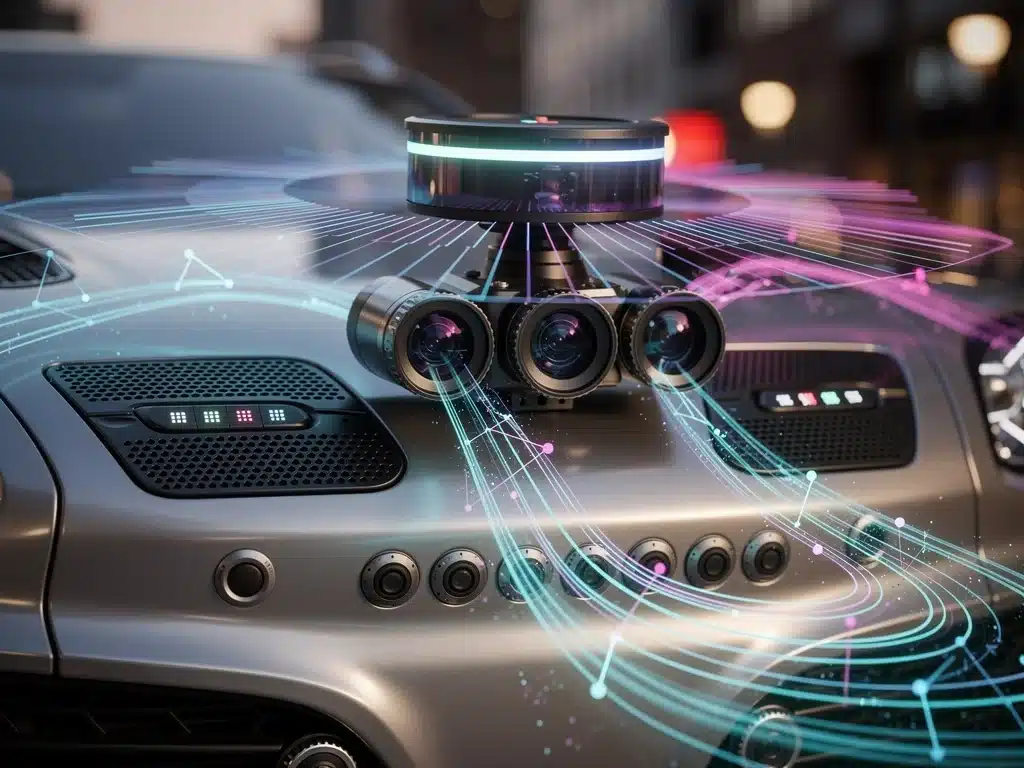
Various sensor technologies each offer unique advantages and limitations, necessitating a multi-modal approach for comprehensive environmental perception. The fusion of data from these diverse sources is critical for robust and reliable autonomous driving.
- LiDAR (Light Detection and Ranging): Generates highly accurate 3D maps of the environment, crucial for precise object detection and localization.
- Radar (Radio Detection and Ranging): Excellent for measuring speed and distance, particularly effective in adverse weather conditions like fog or heavy rain.
- Cameras: Provide rich visual information, essential for object classification, traffic sign recognition, and lane detection.
- Ultrasonic Sensors: Primarily used for short-range detection, ideal for parking assistance and low-speed maneuvers.
Each sensor type contributes a vital layer of information, and their combined strengths mitigate individual weaknesses. For instance, while cameras struggle in low light, LiDAR and radar can maintain performance, forming a resilient perception system. The integration of AI further enhances the processing and interpretation of this complex data stream, leading to more intelligent and reliable vehicle behavior.
AI’s transformative impact on sensor data processing
The sheer volume and complexity of data generated by autonomous vehicle sensors would overwhelm traditional processing methods. This is where artificial intelligence steps in, not merely as an add-on, but as an indispensable core component. AI algorithms, particularly those based on deep learning, are adept at extracting meaningful patterns and insights from raw sensor data, transforming it into actionable information for the vehicle’s decision-making systems.
AI’s role extends beyond simple data interpretation; it enables advanced capabilities such as predictive analytics, anomaly detection, and real-time scene understanding. This allows autonomous vehicles to anticipate potential hazards, understand complex traffic scenarios, and make more informed decisions, significantly enhancing both safety and driving efficiency. The continuous refinement of these AI models is key to achieving higher levels of autonomy.
Enhancing perception through AI-powered sensor fusion
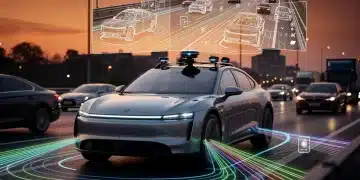
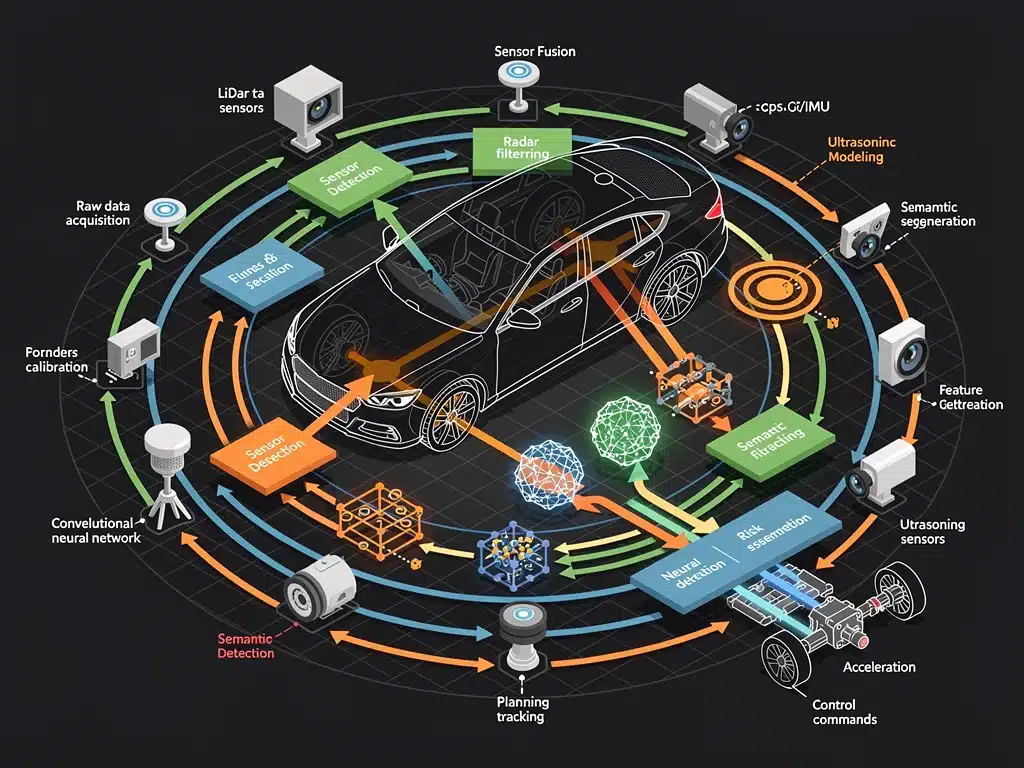
Sensor fusion, the process of combining data from multiple sensors, is dramatically improved by AI. Instead of simply overlaying data, AI algorithms can intelligently integrate inputs, resolve discrepancies, and create a more accurate and robust environmental model than any single sensor could provide alone. This holistic view is critical for navigating dynamic and unpredictable real-world scenarios.
AI-driven sensor fusion techniques leverage sophisticated neural networks to learn optimal ways of combining data. For example, a camera might identify a pedestrian, while LiDAR confirms their precise distance and movement. AI seamlessly integrates these pieces of information, reducing false positives and negatives, and presenting a coherent picture to the vehicle’s control system. This synergy is a cornerstone of reliable autonomous driving.
Anticipated 15% efficiency boost by 2026: what it means
The projected 15% efficiency boost by 2026 represents a significant leap forward in autonomous vehicle capabilities. This isn’t just about speed; it encompasses a broader spectrum of performance metrics, including improved reaction times, more precise navigation, optimized energy consumption, and enhanced operational reliability. This efficiency gain will be a direct result of more sophisticated AI algorithms processing richer sensor data with greater accuracy and speed.
This boost translates into tangible benefits: vehicles will operate more smoothly, consume less fuel or battery power, and navigate complex urban environments with greater agility. For fleet operators, this means reduced operating costs and increased uptime. For individual users, it promises a more comfortable, safer, and ultimately more enjoyable autonomous driving experience. The impact will be felt across the entire automotive ecosystem.
Key areas benefiting from increased efficiency
The expected efficiency improvements will manifest in several critical aspects of autonomous vehicle operation, fundamentally enhancing their performance and economic viability.
- Optimized Route Planning: AI will enable real-time adjustments to routes based on live traffic, weather, and road conditions, minimizing travel time and energy use.
- Reduced Computational Load: More efficient AI models will require less processing power, leading to lower energy consumption and allowing for more complex tasks to be performed on-board.
- Enhanced Predictive Capabilities: AI’s ability to predict future movements of other road users will allow for smoother acceleration, braking, and steering, contributing to fuel economy and passenger comfort.
- Improved Sensor Calibration and Maintenance: AI can monitor sensor performance, detect anomalies, and even predict maintenance needs, ensuring optimal operation and reducing downtime.
These advancements collectively contribute to a more streamlined and resource-effective autonomous driving system. The 15% efficiency boost is not a singular metric but a composite of these interconnected improvements, all driven by deeper AI integration. This holistic enhancement is crucial for the widespread adoption and economic sustainability of autonomous technology.
Challenges and opportunities in AI-sensor integration
While the prospects for AI integration in autonomous vehicle sensors are incredibly promising, the path forward is not without its challenges. Developing AI models that are robust, reliable, and capable of operating safely under all conceivable conditions is a monumental task. Ensuring data privacy and cybersecurity in systems that collect and process vast amounts of real-time information also presents significant hurdles.
However, these challenges also present immense opportunities for innovation. The need for advanced AI algorithms, specialized hardware, and secure data architectures is driving research and development across numerous industries. Companies that can effectively address these challenges will be at the forefront of the autonomous revolution, shaping the future of transportation and beyond.
One of the most pressing challenges is the need for explainable AI (XAI). In safety-critical applications like autonomous driving, it’s not enough for an AI to make the correct decision; regulators and the public need to understand *why* a decision was made. This transparency is vital for building trust and enabling rapid debugging and improvement of AI systems. Researchers are actively working on developing XAI techniques that can provide clear, interpretable insights into the decision-making processes of complex neural networks.
Overcoming data privacy and security concerns
The vast amounts of data collected by autonomous vehicles, including location information, passenger behavior, and environmental details, raise significant privacy concerns. Robust cybersecurity measures are essential to protect this sensitive data from breaches and malicious attacks, which could have catastrophic consequences for vehicle safety and public trust. Implementing end-to-end encryption, secure data storage protocols, and advanced intrusion detection systems are critical steps.
Furthermore, the ethical implications of data ownership and usage must be carefully considered. Clear regulations and industry standards are needed to define how this data can be collected, stored, and utilized. Balancing the benefits of data-driven improvements with individual privacy rights will be a continuous challenge that requires collaborative efforts from policymakers, industry leaders, and privacy advocates. Addressing these concerns proactively will be vital for the long-term success and public acceptance of autonomous vehicles.
The evolving landscape of autonomous vehicle perception
The perception capabilities of autonomous vehicles are constantly evolving, driven by advancements in both sensor technology and AI algorithms. What was once considered science fiction is rapidly becoming reality, as vehicles gain an increasingly nuanced understanding of their surroundings. This evolution is not just about detecting objects but about interpreting complex scenes, predicting behaviors, and adapting to unforeseen circumstances with human-like, or even superhuman, precision.
The future of autonomous perception involves more than just better individual sensors; it points towards highly integrated, adaptive systems that can learn and improve over time. The goal is to move beyond reactive driving to proactive, predictive navigation, where vehicles can anticipate events several seconds in advance, allowing for smoother and safer maneuvers. This continuous learning loop, powered by AI, is at the heart of the next generation of autonomous driving.
The integration of V2X (Vehicle-to-Everything) communication further enhances the perception landscape. By communicating with other vehicles (V2V), infrastructure (V2I), and even pedestrians’ devices (V2P), autonomous cars can gain information that is beyond the line of sight of their on-board sensors. This collective intelligence, processed by AI, provides an even richer context for decision-making, especially in complex traffic scenarios or areas with limited sensor visibility.
The role of edge AI and cloud computing
The processing power required for advanced AI in autonomous vehicles is immense. Edge AI, where computations occur directly on the vehicle’s hardware, enables real-time decision-making without latency. However, for training complex models, software updates, and aggregating data from entire fleets, cloud computing remains indispensable. The synergy between edge and cloud AI is critical for scalable and continuously improving autonomous systems.
- Edge AI: Provides instant processing for critical functions like object detection and collision avoidance, ensuring immediate responses.
- Cloud AI: Facilitates large-scale data analysis, model training, and over-the-air updates, enabling continuous learning and improvement across the fleet.
- Hybrid Architectures: A combination of edge and cloud processing allows for optimal balance between real-time performance and long-term intelligence development.
This distributed intelligence architecture ensures that autonomous vehicles are both responsive in the moment and continuously evolving in their capabilities. As AI models become more sophisticated, the efficient allocation of computational tasks between edge and cloud will be a key factor in maximizing the efficiency boost and overall performance of autonomous systems.
Regulatory frameworks and public acceptance in 2026
As autonomous vehicle technology advances rapidly, regulatory frameworks and public acceptance become increasingly critical factors for widespread deployment. By 2026, it is anticipated that more standardized regulations will emerge, providing clearer guidelines for testing, deployment, and liability. These frameworks are essential for fostering innovation while ensuring public safety and trust.
Public acceptance, or the lack thereof, can significantly impact the pace of adoption. Addressing concerns about safety, job displacement, and ethical dilemmas through transparent communication and proven reliability will be paramount. The 15% efficiency boost in AI-integrated sensors will play a crucial role in building confidence, demonstrating the tangible benefits and enhanced safety that these advanced systems can offer.
Several countries and regions are already developing pilot programs and legislative initiatives to accommodate autonomous vehicles. These early efforts are crucial for gathering real-world data, identifying unforeseen challenges, and iteratively refining regulations. International collaboration on standards will also be vital to ensure seamless cross-border operation and global market growth for autonomous technologies.
Building trust through safety and transparency
The primary driver for public acceptance of autonomous vehicles is undeniable safety. The efficiency boost provided by AI-integrated sensors directly contributes to this by enhancing the vehicle’s ability to perceive and react to its environment more effectively than human drivers in many situations. Demonstrating a statistically significant reduction in accidents will be the most compelling argument for widespread adoption.
Transparency in how these systems operate, including clear explanations of their capabilities and limitations, is also vital. Educating the public about the benefits, addressing misconceptions, and providing opportunities for direct experience with autonomous technology will help to demystify the technology and build confidence. By 2026, a proven track record of safety and a clear communication strategy will be essential for overcoming skepticism and fostering broad public trust in AI-driven autonomous mobility.
The future roadmap: beyond 2026 for AI in AV sensors
While the 2026 outlook for AI integration in autonomous vehicle sensors is exciting, it represents just another significant milestone on a much longer journey. The future roadmap extends far beyond this point, envisioning even more sophisticated AI models, novel sensor technologies, and increasingly seamless integration into smart city infrastructures. The pursuit of full Level 5 autonomy, where vehicles can operate completely without human intervention under all conditions, remains the ultimate goal.
The continuous innovation in AI, particularly in areas like reinforcement learning and generative AI, promises to unlock new levels of intelligence for autonomous systems. Imagine vehicles that can not only react to but also proactively negotiate with human drivers, learn from novel situations in real-time, and even adapt their driving style to passenger preferences. The possibilities are vast, and the pace of development shows no signs of slowing down.
The next decade will likely see the emergence of ‘sentient’ vehicles that possess a deeper understanding of human intent and social cues, moving beyond purely technical perception. This could involve AI interpreting subtle body language of pedestrians or understanding the unwritten rules of human driving behavior, leading to more natural and harmonious interactions on the road. The convergence of AI, sensor technology, and connectivity will pave the way for truly intelligent and context-aware autonomous systems.
Emerging sensor technologies and AI paradigms
Beyond current sensor modalities, research is exploring new technologies that could further enhance autonomous perception. Thermal cameras, for example, can detect living beings based on heat signatures, offering advantages in low-light or foggy conditions. Advanced forms of radar that can classify objects with greater detail are also under development. Concurrently, AI research is pushing the boundaries with:
- Neuromorphic Computing: Hardware designed to mimic the human brain, offering ultra-low power consumption and high efficiency for AI processing.
- Federated Learning: Allows AI models to be trained on decentralized datasets from multiple vehicles without sharing raw data, addressing privacy concerns.
- Digital Twin Technology: Creating virtual replicas of vehicles and environments for extensive simulation and AI model training, accelerating development and testing.
These emerging technologies and AI paradigms will collectively contribute to a future where autonomous vehicles are not only more efficient but also more robust, adaptable, and integrated into our daily lives. The period beyond 2026 will be characterized by a relentless drive towards perfecting the autonomous driving experience, making it safer, more accessible, and profoundly transformative.
| Key Aspect | 2026 Outlook & Impact |
|---|---|
| Efficiency Boost | Expected 15% increase in operational efficiency due to advanced AI, leading to smoother, safer, and more economical autonomous driving. |
| Sensor Fusion | AI-driven fusion of LiDAR, radar, and camera data creates a more robust and accurate environmental perception, reducing errors. |
| Challenges Addressed | Progress in explainable AI, cybersecurity, and data privacy will build greater trust and regulatory clarity. |
| Future Advancements | Beyond 2026, emphasis on sentient AI, V2X communication, and neuromorphic computing for full Level 5 autonomy. |
Frequently asked questions about AI in autonomous vehicles
The 15% efficiency boost signifies enhanced operational performance, including quicker reaction times, more precise navigation, optimized energy consumption, and increased reliability. It translates to safer, smoother, and more cost-effective autonomous driving experiences for both users and fleet operators.
AI enhances safety by enabling superior sensor fusion, allowing vehicles to create a more accurate and comprehensive environmental model. It also facilitates predictive analytics, helping vehicles anticipate potential hazards and make proactive decisions, thereby significantly reducing the likelihood of accidents.
Autonomous vehicles commonly use a combination of LiDAR for 3D mapping, radar for distance and speed detection, cameras for visual recognition, and ultrasonic sensors for short-range object detection. AI integrates data from these diverse sensors for robust perception.
Key challenges include developing explainable AI for transparency, ensuring robust cybersecurity against threats, addressing data privacy concerns, and creating comprehensive regulatory frameworks. Overcoming these will be crucial for widespread adoption and public trust.
Beyond 2026, the focus will shift towards achieving full Level 5 autonomy, incorporating more advanced AI like neuromorphic computing, and leveraging V2X communication for enhanced collective intelligence. Vehicles will become more adaptive, predictive, and integrated into smart city ecosystems.
Conclusion
The year 2026 marks a critical inflection point for AI integration in autonomous vehicle sensors, with a projected 15% efficiency boost poised to redefine the capabilities and reliability of self-driving technology. This enhancement is not merely an incremental improvement but a fundamental step towards safer, more efficient, and ultimately more accessible autonomous mobility. The continuous evolution of AI algorithms, coupled with advancements in sensor technology and robust regulatory frameworks, will pave the way for a future where autonomous vehicles are an integral and trusted part of our daily lives, transforming urban landscapes and personal transportation experiences alike. Addressing the remaining challenges in data privacy, security, and public acceptance will be paramount as the industry moves confidently towards a fully autonomous future.