ADAS Innovations: Safer Roads by 2026
Advertisements
Advanced Driver-Assistance Systems (ADAS) are rapidly evolving, with key innovations set to significantly enhance vehicle safety and transform the driving experience by 2026, creating a new era of proactive accident prevention.
The automotive landscape is undergoing a profound transformation, driven by technological advancements aimed at making our journeys safer and more efficient. Among these, Advanced Driver-Assistance Systems (ADAS) stand out as crucial components, continuously evolving to improve vehicle and road safety. By 2026, we anticipate the widespread integration of groundbreaking ADAS innovations that promise to redefine how we interact with our vehicles and the environment.
Advertisements
The Evolution of ADAS: Beyond Basic Safety Features
Advanced Driver-Assistance Systems (ADAS) have moved far beyond their initial role of simply warning drivers. What began with features like anti-lock brakes and cruise control has blossomed into a sophisticated suite of technologies designed to prevent accidents, mitigate their severity, and even take partial control of the vehicle when necessary. This evolution is driven by a combination of more powerful sensors, artificial intelligence, and faster processing capabilities.
Early ADAS systems focused primarily on reactive measures, such as deploying airbags or tightening seatbelts after an impact. However, the paradigm has shifted towards proactive accident avoidance. Modern ADAS actively monitors the driving environment, identifies potential hazards, and intervenes to prevent collisions before they occur. This proactive approach is fundamental to achieving the ultimate goal of accident-free roads.
Sensor Fusion: The Brains of Modern ADAS
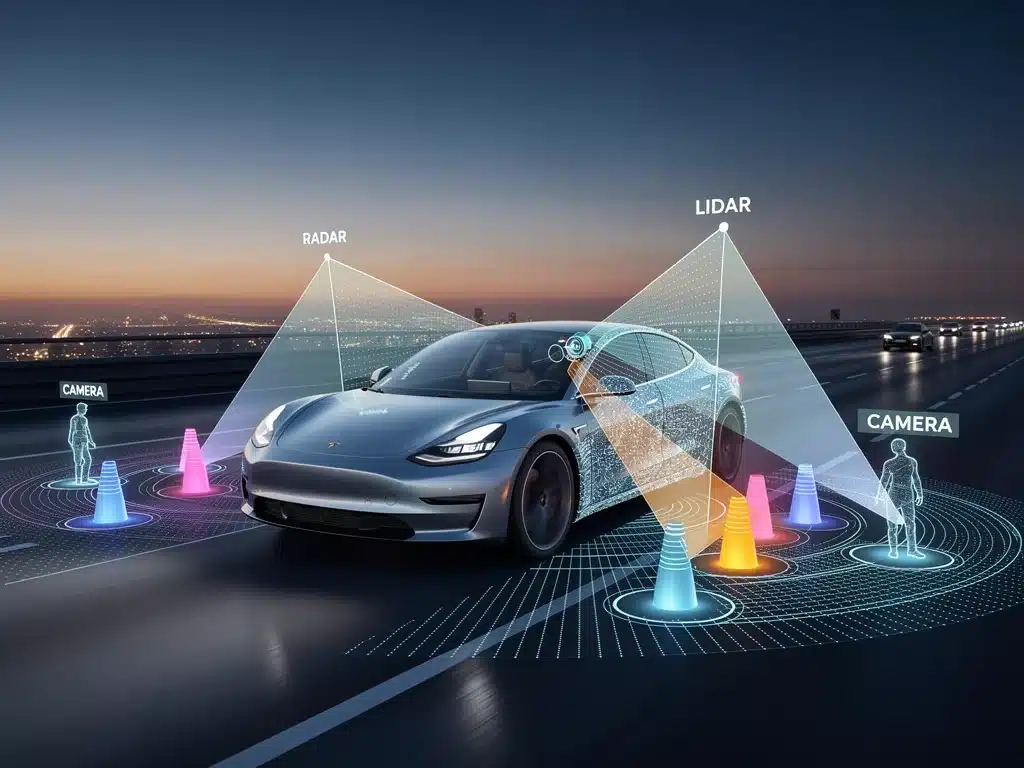
At the heart of advanced ADAS is sensor fusion, a process where data from multiple types of sensors—like cameras, radar, lidar, and ultrasonic sensors—are combined and interpreted by a central processing unit. This comprehensive data stream provides a more accurate and robust understanding of the vehicle’s surroundings than any single sensor could offer.
- Redundancy: If one sensor is obstructed or fails, others can compensate.
- Accuracy: Combining diverse data types reduces false positives and improves object detection.
- Robustness: Systems perform better in various weather conditions and lighting scenarios.
The ability to fuse sensor data effectively allows ADAS to perceive the world in a richer, more nuanced way, enabling features like advanced automatic emergency braking and sophisticated lane-keeping assistance. This integrated approach is essential for the reliability and trustworthiness of the systems.
The continuous development in sensor technology, coupled with advancements in machine learning algorithms, allows for increasingly complex scenarios to be handled by ADAS. This includes distinguishing between different types of road users, predicting their movements, and adapting vehicle behavior accordingly. The net result is a significant reduction in driver workload and an enhancement of overall safety on the road.
Innovation 1: Hyper-Accurate Predictive Collision Avoidance
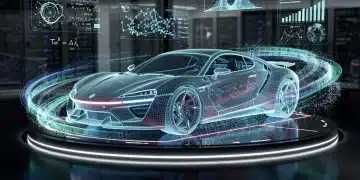
One of the most significant advancements in ADAS for 2026 is the emergence of hyper-accurate predictive collision avoidance systems. These next-generation systems move beyond simple proximity warnings to actively predict potential collision trajectories with unprecedented precision. They leverage vast amounts of real-time data, advanced algorithms, and enhanced sensor capabilities to anticipate risks moments before they become critical.
Traditional collision warning systems typically alert the driver when a potential impact is imminent, sometimes initiating automatic braking. However, these new systems analyze complex variables, including the speed and trajectory of multiple vehicles, pedestrian movements, and even road surface conditions, to calculate the probability and severity of a collision. This allows for more timely and nuanced interventions, giving drivers more time to react or the system to take corrective action.
AI and Machine Learning for Risk Assessment
The backbone of hyper-accurate predictive collision avoidance lies in sophisticated artificial intelligence (AI) and machine learning (ML) models. These models are trained on massive datasets of real-world driving scenarios, allowing them to recognize patterns and predict outcomes with remarkable accuracy. They learn from every mile driven, continuously refining their ability to assess risk.
- Contextual Understanding: AI can differentiate between a car braking abruptly in traffic and one swerving to avoid a sudden obstacle.
- Behavioral Prediction: ML algorithms can anticipate the likely actions of other drivers or pedestrians based on their current movements.
- Dynamic Risk Scoring: The system continuously calculates a real-time risk score, dynamically adjusting its response.
These intelligent systems can not only warn the driver but also perform evasive steering maneuvers or apply brakes with optimized force to prevent or minimize a collision. This level of predictive capability represents a substantial leap forward in active safety technology.
The integration of deep learning techniques allows these systems to handle unforeseen situations more effectively, adapting to new challenges on the road. This means that even in highly dynamic and unpredictable urban environments, the system can provide a robust layer of safety, significantly reducing the likelihood of accidents. The continuous learning aspect ensures that the systems become more proficient over time, making them increasingly reliable.
Innovation 2: Advanced Augmented Reality Head-Up Displays (AR HUDs)
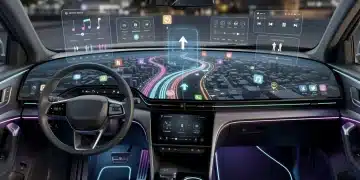
Augmented Reality Head-Up Displays (AR HUDs) are set to revolutionize how drivers receive critical information, transforming the windshield into an interactive display. Unlike traditional HUDs that project basic data, advanced AR HUDs seamlessly overlay digital information directly onto the real-world view, making navigation, hazard warnings, and speed limits intuitively visible without diverting the driver’s gaze from the road.
These systems integrate with the vehicle’s ADAS sensors to identify and highlight relevant objects in the driver’s field of vision. For example, navigation arrows appear to float directly on the road ahead, guiding the driver through complex intersections. Pedestrians or cyclists at risk can be highlighted, and potential collision points can be marked, providing immediate and contextual awareness.
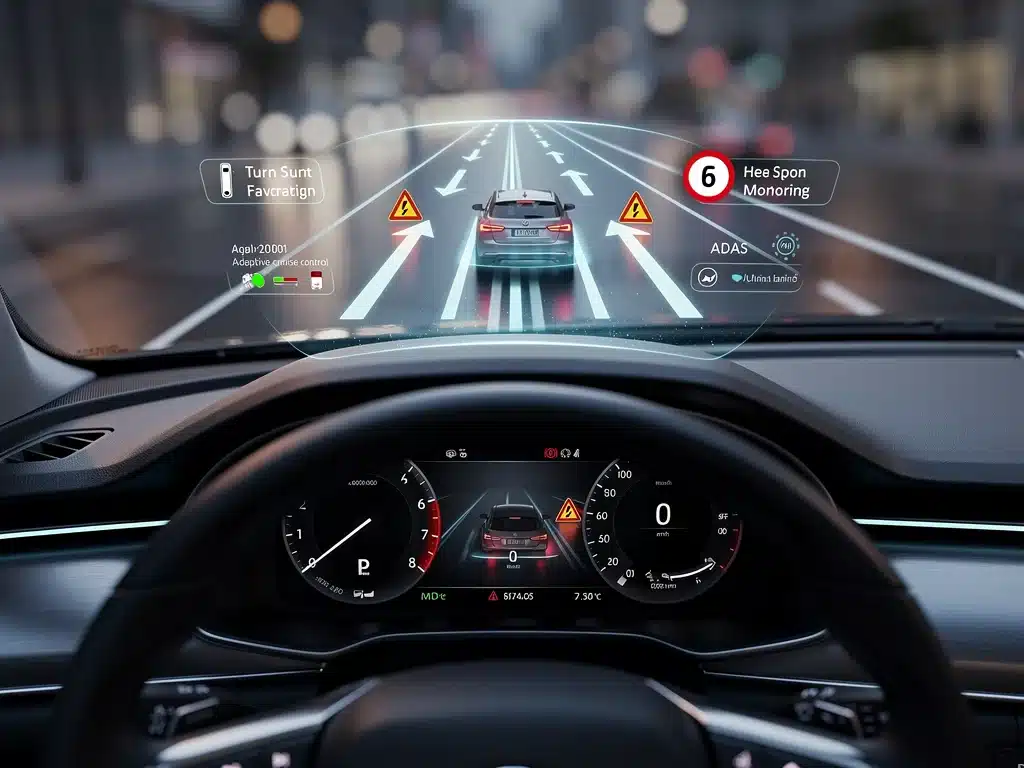
The primary benefit of AR HUDs is their ability to reduce cognitive load and reaction time. By presenting information in a highly intuitive and integrated manner, drivers can process critical data more quickly and make decisions faster. This direct presentation of information eliminates the need for drivers to constantly shift their focus between the road and the instrument cluster or infotainment screen.
Seamless Integration with ADAS Features
Advanced AR HUDs are not merely display technologies; they are integral components of the ADAS ecosystem. They work in conjunction with other ADAS features to enhance their effectiveness.
- Lane Keeping Assist: AR lines can visually guide the driver within their lane, making lane departure warnings more intuitive.
- Adaptive Cruise Control: The system can highlight the vehicle being tracked by ACC, providing clear visual confirmation.
- Traffic Sign Recognition: Speed limits and other road signs are projected directly onto the relevant signs in the real world.
This seamless integration creates a more cohesive and less distracting driving experience. The information presented is always relevant to the immediate driving situation, enhancing situational awareness and contributing significantly to overall road safety. The visual cues provided by AR HUDs can be particularly helpful in challenging driving conditions, such as heavy rain or fog, where traditional visual cues might be obscured.
The development of holographic and volumetric display technologies is pushing the boundaries of AR HUDs, promising even more immersive and realistic projections. These advancements will further blur the lines between the digital and physical worlds, providing drivers with an unparalleled level of information processing and decision support. The contextual display of information means that drivers receive exactly what they need, precisely when they need it, leading to a safer and more confident driving experience.
Innovation 3: Vehicle-to-Everything (V2X) Communication for Cooperative Safety
Vehicle-to-Everything (V2X) communication is a revolutionary ADAS innovation that allows vehicles to communicate with each other (V2V), with infrastructure (V2I), with pedestrians (V2P), and even with the network (V2N). This interconnected network creates a cooperative safety environment, where vehicles share real-time information about their location, speed, and intentions, dramatically expanding the scope of accident prevention.
Imagine a scenario where your car knows about a sudden braking event several vehicles ahead, even if it’s out of your line of sight. Or, imagine traffic lights adjusting their timing based on the flow of approaching vehicles, reducing congestion and the risk of red-light violations. V2X makes these scenarios a reality, providing a collective awareness that far surpasses the capabilities of individual vehicle sensors.
Enhancing Situational Awareness and Preventing Accidents
V2X communication significantly enhances situational awareness by providing a comprehensive, 360-degree view of the entire road network. This capability is particularly vital in situations where direct line-of-sight is obstructed or limited.
- Intersection Collision Avoidance: Vehicles can warn each other of potential collisions at blind intersections.
- Work Zone Safety: Drivers are alerted to upcoming construction zones and workers, improving safety for all.
- Emergency Vehicle Pre-emption: Vehicles can receive warnings about approaching emergency vehicles, allowing them to yield safely.
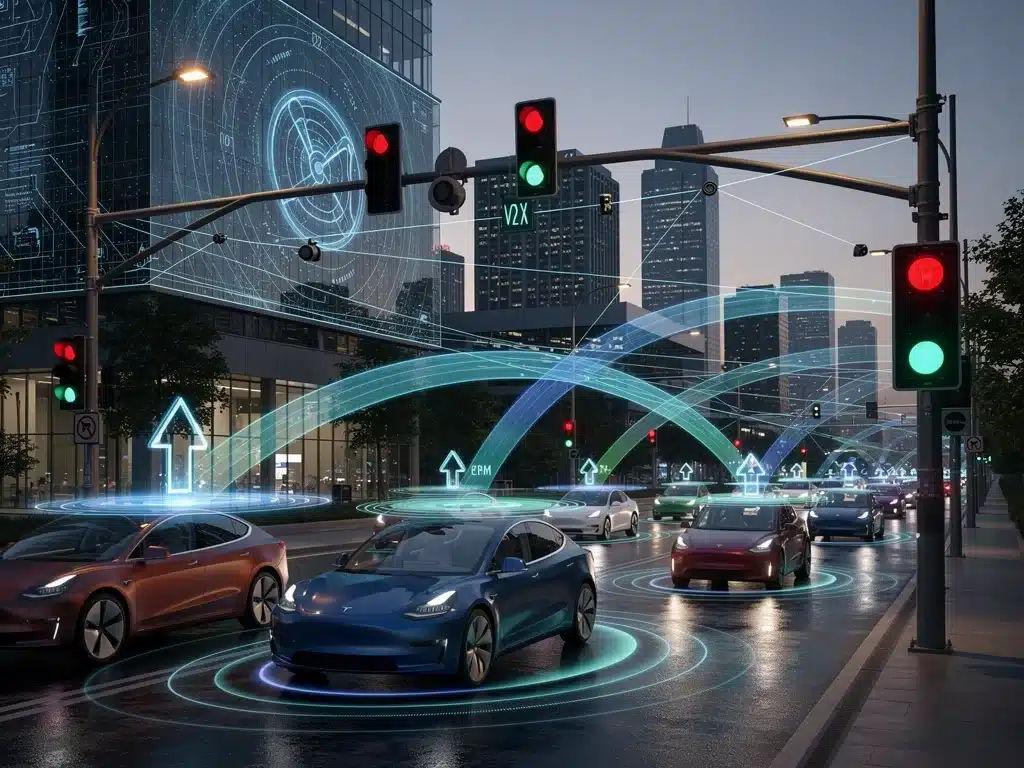
By sharing data, vehicles can collectively anticipate and react to hazards that would be impossible for a single vehicle to detect. This cooperative approach not only prevents accidents but also optimizes traffic flow, reduces emissions, and enhances the overall efficiency of transportation systems. The real-time exchange of information creates a dynamic, responsive driving environment.
The deployment of 5G technology is accelerating the potential of V2X, enabling ultra-low latency and high-bandwidth communication, which are critical for safety-critical applications. This robust communication infrastructure will facilitate the rapid exchange of vast amounts of data, making V2X systems even more responsive and reliable. The collaborative nature of V2X means that the safety benefits multiply as more vehicles and infrastructure elements become connected, leading to a truly intelligent transportation system.
The Broader Impact of ADAS Innovations on Road Safety
The cumulative effect of these ADAS innovations extends far beyond individual vehicle safety. Their widespread adoption promises a transformative impact on overall road safety statistics, significantly reducing the number of accidents, injuries, and fatalities. As vehicles become more intelligent and interconnected, the margin for human error, which is a leading cause of accidents, is progressively diminished.
These systems contribute to a more predictable and harmonious traffic flow, reducing instances of sudden braking, aggressive lane changes, and other behaviors that can lead to collisions. The consistent and proactive intervention of ADAS helps to smooth out driving patterns, creating a less stressful and ultimately safer environment for all road users, including pedestrians and cyclists.
Addressing Human Error and Fatigue
Human error remains a primary factor in most road accidents. ADAS innovations are specifically designed to counteract common human failings such as distraction, fatigue, and impaired judgment. By providing constant monitoring and timely interventions, these systems act as an invaluable co-pilot, enhancing the driver’s capabilities.
- Distraction Mitigation: AR HUDs keep eyes on the road, while predictive systems anticipate threats even if the driver is momentarily distracted.
- Fatigue Detection: Some ADAS systems can monitor driver alertness and suggest breaks, reducing the risk of fatigue-related accidents.
- Enhanced Perception: Sensors can detect objects and conditions that might be missed by human senses, especially in adverse weather or low light.
The goal is not to replace the driver entirely, but to create a symbiotic relationship where technology augments human capabilities, making driving safer and more reliable. This partnership between human and machine is crucial for the transition towards higher levels of automated driving, where the driver can gradually cede more control to the vehicle in specific situations.
Moreover, the data collected by these advanced ADAS can be invaluable for urban planning and traffic management. By understanding common accident hotspots and patterns, city planners can design safer roads and intersections, further contributing to a reduction in road incidents. This holistic approach to safety, integrating technology, human behavior, and infrastructure, is the key to achieving a truly accident-free future.
Challenges and the Path to Widespread Adoption
While the promise of these ADAS innovations is immense, their widespread adoption and full realization face several challenges. These include the cost of implementation, standardization across different manufacturers, ensuring cybersecurity, and addressing public perception and trust. Overcoming these hurdles is crucial for these technologies to deliver their full safety potential.
The cost of integrating advanced sensors, powerful processors, and sophisticated software can increase vehicle prices, potentially limiting access for some consumers. Manufacturers are working on economies of scale and modular designs to make these technologies more affordable. Standardization is also vital to ensure seamless communication and interoperability between vehicles from different brands and with varying infrastructure components.
Regulatory Frameworks and Public Acceptance
Developing robust regulatory frameworks is essential to govern the testing, deployment, and performance standards of these advanced ADAS. Governments and international bodies are actively working on creating clear guidelines to ensure safety, reliability, and accountability. This includes defining levels of automation and establishing liability in the event of an accident involving ADAS-equipped vehicles.
- Data Privacy: Ensuring the secure handling of sensitive driving data collected by ADAS.
- Software Updates: Establishing protocols for over-the-air updates to maintain system integrity and introduce new features.
- Driver Education: Educating the public on how to effectively use and trust ADAS features.
Public acceptance is another critical factor. Drivers need to understand the benefits and limitations of these systems to use them effectively and confidently. Building trust through transparent communication, rigorous testing, and consistent performance will be key to encouraging widespread adoption. The perception of ADAS as a helpful assistant rather than a replacement for human control is vital for successful integration.
Addressing cybersecurity concerns is paramount, as connected vehicles become potential targets for malicious attacks. Robust security protocols and continuous monitoring are necessary to protect vehicle systems from unauthorized access or manipulation. The collaboration between industry, government, and cybersecurity experts is crucial to build a resilient and trustworthy automotive ecosystem for the future.
| Key ADAS Innovation | Brief Description |
|---|---|
| Predictive Collision Avoidance | AI-driven systems anticipate and prevent collisions with hyper-accuracy, analyzing complex real-time data. |
| Advanced AR Head-Up Displays | Projects critical navigation and hazard warnings directly onto the road view, enhancing driver focus. |
| Vehicle-to-Everything (V2X) Communication | Enables vehicles to communicate with each other and infrastructure for cooperative safety awareness. |
Frequently Asked Questions About ADAS Innovations
ADAS refers to electronic systems in vehicles that assist drivers in driving and parking functions. They are designed to increase vehicle and road safety through a human-machine interface, reducing human error and preventing accidents by providing warnings or taking corrective actions.
These systems use AI and advanced sensors to predict potential collisions more accurately and earlier than current systems. By anticipating risks, they can provide more timely warnings or initiate evasive maneuvers, giving drivers or the vehicle more time to react and prevent accidents before they become critical.
Advanced AR HUDs project critical driving information, like navigation and hazard warnings, directly onto the driver’s view of the road. This reduces the need for drivers to look away from the road, decreasing cognitive load and improving reaction times, leading to a safer and more intuitive driving experience.
V2X communication allows vehicles to share information with each other and with infrastructure, creating a cooperative safety network. This provides a broader awareness of road conditions and potential hazards beyond the vehicle’s own sensors, enabling proactive accident prevention and smoother traffic flow.
Key challenges include the cost of technology integration, standardization across manufacturers, ensuring robust cybersecurity, and gaining public trust and acceptance. Addressing these aspects through regulation, education, and continuous improvement is essential for ADAS to reach its full potential in enhancing road safety.
Conclusion
The rapid advancement of Advanced Driver-Assistance Systems (ADAS) is fundamentally reshaping the future of road safety. By 2026, innovations such as hyper-accurate predictive collision avoidance, advanced augmented reality head-up displays, and comprehensive vehicle-to-everything communication will move beyond theoretical concepts to become integral parts of our daily driving experience. These technologies, working in concert, promise to significantly reduce accidents, mitigate injuries, and create a more efficient and harmonious transportation ecosystem. While challenges remain in terms of cost, standardization, and public acceptance, the trajectory towards safer and smarter roads powered by ADAS is clear and irreversible, ushering in an era where driving is not only more convenient but also inherently more secure for everyone.