V2X Communication: Impact on Traffic Flow by 2026
Advertisements
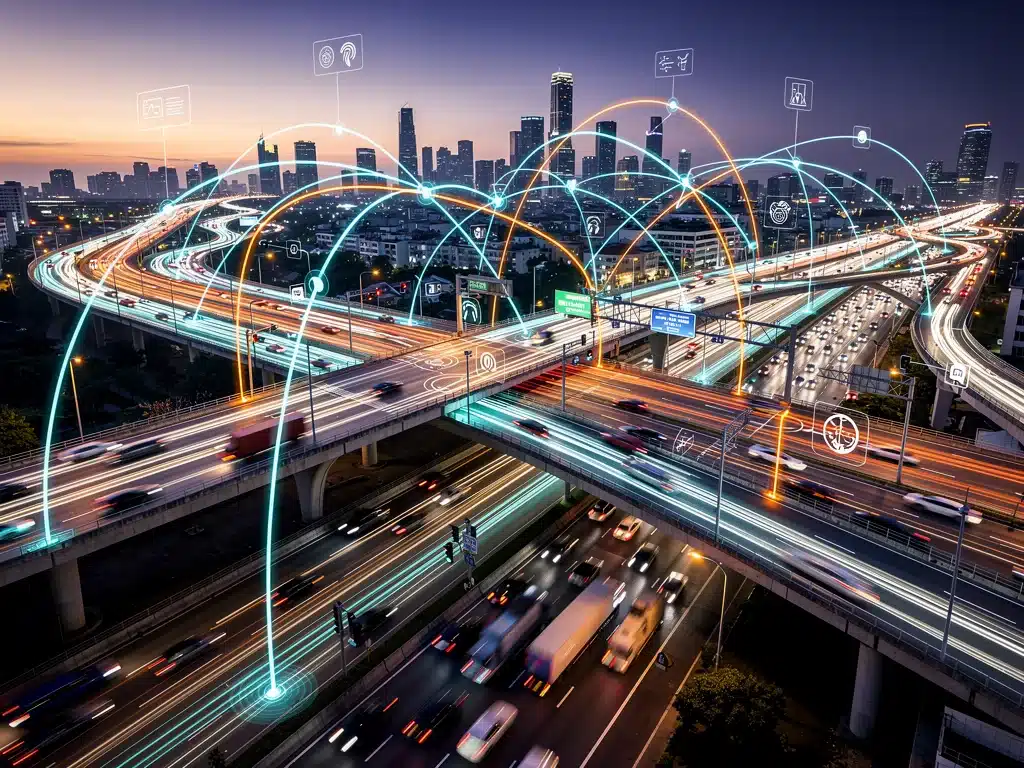
Vehicle-to-Everything (V2X) communication is poised to fundamentally reshape urban and highway traffic flow by 2026, fostering a more connected, efficient, and safer transportation ecosystem across the United States.
The landscape of transportation is on the cusp of an unparalleled transformation, with Vehicle-to-Everything (V2X) communication: understanding its impact on traffic flow by 2026 emerging as a pivotal technology. Imagine a world where vehicles, infrastructure, and even pedestrians communicate seamlessly, anticipating hazards and optimizing routes in real-time. This isn’t a distant sci-fi fantasy; it’s the near future, driven by V2X, promising to alleviate congestion, enhance safety, and redefine our commuting experience. Let’s delve into how this revolutionary technology will reshape traffic dynamics in the coming years.
Advertisements
The foundational principles of V2X communication
Understanding V2X communication begins with grasping its core components and how they interact. This technology isn’t a single entity but a comprehensive ecosystem of interconnected communication modalities, each playing a crucial role in creating a truly intelligent transportation system. By 2026, these foundational principles will be more robust and widespread, forming the backbone of smart mobility.
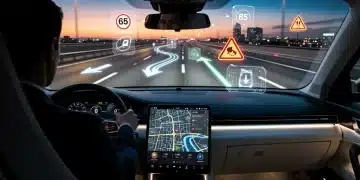
At its heart, V2X encompasses several distinct communication types, all designed to facilitate a continuous exchange of data. This data includes everything from vehicle speed and position to road conditions, traffic signal timings, and even pedestrian presence. The goal is to provide a 360-degree awareness that far exceeds what a human driver or even individual sensors can achieve.
Vehicle-to-Vehicle (V2V) communication
V2V communication is perhaps the most intuitive aspect of V2X. It involves direct, wireless data exchange between nearby vehicles, enabling them to share critical information instantly. This direct line of communication is vital for preventing accidents, especially those caused by sudden braking or blind spots.
- Collision avoidance: Vehicles can alert each other to potential crash risks.
- Platooning: Groups of vehicles can travel closely together, improving aerodynamic efficiency and road capacity.
- Congestion warnings: Drivers receive real-time alerts about slowdowns ahead, allowing for proactive route adjustments.
Vehicle-to-Infrastructure (V2I) communication
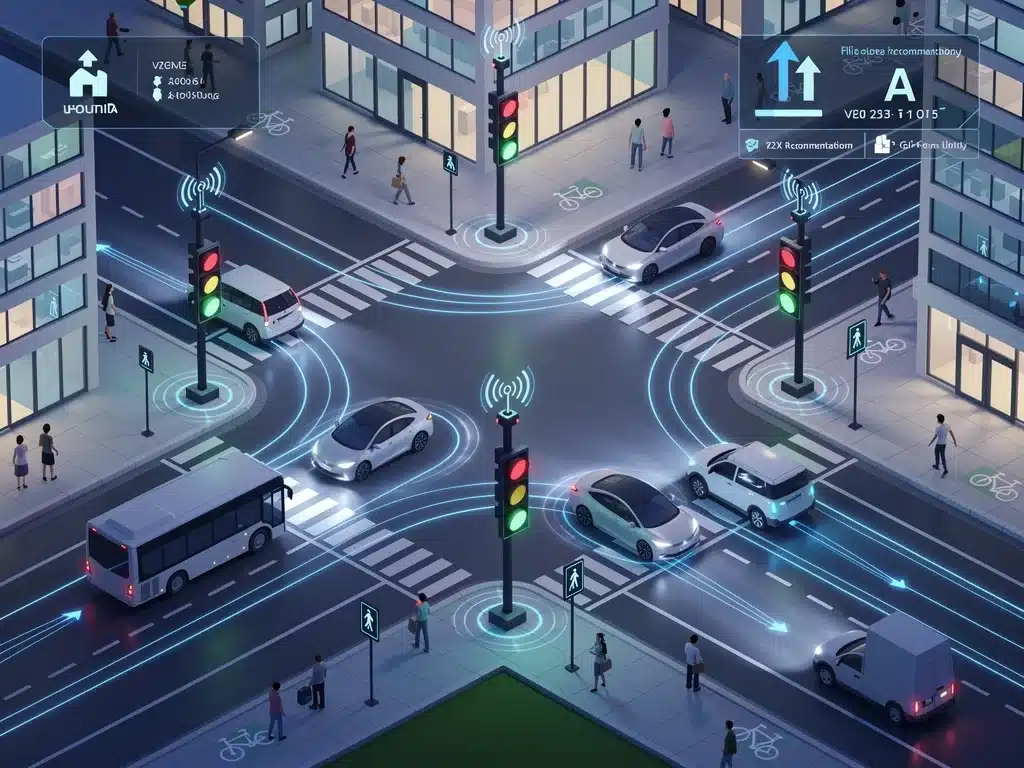
V2I connects vehicles with roadway infrastructure such as traffic lights, road signs, and construction zones. This link is essential for intelligent traffic management and providing drivers with up-to-the-minute information about their environment beyond just other vehicles.
- Traffic signal optimization: Vehicles can receive signal phase and timing information, reducing unnecessary stops and idling.
- Dynamic speed limits: Infrastructure can broadcast variable speed limits based on real-time conditions like weather or congestion.
- Smart parking: Information on available parking spaces can be relayed directly to vehicles.
The combination of V2V and V2I forms the cornerstone of V2X, creating a dynamic and responsive network. This intricate web of communication is what will ultimately drive significant improvements in traffic flow and safety, making our roads smarter and more efficient. As we move closer to 2026, the integration of these technologies will become increasingly sophisticated, laying the groundwork for truly autonomous driving and hyper-efficient transportation networks.
Enhanced safety and collision avoidance
One of the most compelling benefits of V2X communication is its profound impact on road safety. By enabling vehicles to ‘see’ and ‘understand’ their surroundings far beyond the limitations of human perception or individual sensors, V2X promises a dramatic reduction in traffic accidents and fatalities. This enhanced awareness is not just about avoiding immediate collisions but also about creating a more predictable and less stressful driving environment for everyone on the road.
The real-time exchange of data between vehicles and infrastructure provides an early warning system that can detect potential hazards long before a driver might. This proactive approach to safety is a game-changer, moving us from reactive accident response to preventative measures.
Predictive collision warnings
V2V communication allows vehicles to broadcast their speed, heading, and braking status to surrounding vehicles. If a car ahead brakes suddenly or an unseen vehicle is approaching an intersection, V2X systems can immediately alert the driver, or even autonomously apply brakes, significantly reducing reaction time. This capability is paramount in scenarios like:
- Blind spot warnings: Detecting vehicles in blind spots and alerting the driver.
- Intersection collision warnings: Warning of potential collisions with vehicles approaching from cross streets.
- Lane change assistance: Providing alerts if a lane change maneuver is unsafe due to another vehicle’s presence.
Hazardous road condition alerts
V2I communication plays a critical role in informing drivers about adverse road conditions ahead. Imagine knowing about black ice around the bend or a sudden downpour before you even see it. This type of information, transmitted from roadside units or other vehicles, allows drivers to adjust their speed and driving behavior proactively, preventing loss of control and subsequent accidents.
Furthermore, V2X can alert drivers to construction zones, road closures, or emergency vehicle approaches well in advance, giving them ample time to react safely. By 2026, the widespread deployment of these safety features will lead to a noticeable drop in accident rates, making daily commutes much safer. The continuous flow of critical safety data transforms every vehicle into an active participant in a collective safety network, protecting not just its occupants but all road users.
Optimizing traffic flow and reducing congestion
Beyond safety, V2X communication holds immense potential for alleviating one of the most persistent and costly problems in modern transportation: traffic congestion. By enabling intelligent coordination and real-time adaptability, V2X systems can smooth out traffic patterns, reduce delays, and make our roads significantly more efficient. The cumulative effect of these improvements will be felt daily by commuters and businesses alike, translating into saved time and fuel.
The ability of vehicles and infrastructure to communicate directly allows for a level of traffic management that was previously impossible. Instead of relying on static signals or limited sensor data, V2X provides a dynamic, holistic view of traffic conditions.
Intelligent traffic signal management
V2I communication allows traffic lights to become ‘smart.’ Instead of operating on fixed timers, V2I-enabled signals can adjust their timings in real-time based on actual traffic demand. For instance, if a large platoon of vehicles is approaching an intersection, the signal can remain green longer to accommodate them, preventing unnecessary stops and accelerating flow. Conversely, if no vehicles are detected on a particular approach, the signal can prioritize other directions.
This dynamic optimization reduces:
- Idling time: Less time spent waiting at red lights, saving fuel and reducing emissions.
- Travel delays: Smoother movement through intersections, cutting down overall journey times.
- Stop-and-go traffic: By anticipating signal changes, drivers can adjust their speed more gradually, avoiding abrupt braking and acceleration.
Dynamic routing and lane management
V2X also empowers dynamic routing. As vehicles share real-time traffic data, navigation systems can provide more accurate and timely suggestions for alternative routes to avoid congested areas. This collaborative intelligence distributes traffic more evenly across the road network, preventing bottlenecks from forming or escalating.
Furthermore, V2X can facilitate dynamic lane management, allowing for flexible use of lanes based on traffic volume and direction. For example, a shoulder lane might be opened during peak hours, or reversible lanes could be more efficiently managed. By 2026, these capabilities will transform how cities manage their transportation networks, leading to a noticeable reduction in urban congestion and a more fluid movement of vehicles.
Environmental benefits and fuel efficiency
The widespread adoption of V2X communication extends its positive influence beyond just safety and traffic flow, offering significant environmental benefits and improvements in fuel efficiency. By optimizing vehicle movement and reducing congestion, V2X technology directly contributes to a greener, more sustainable transportation ecosystem. These advantages will become increasingly critical as environmental concerns continue to shape policy and consumer choices by 2026.
Reduced idling, smoother acceleration, and more efficient routing all directly translate into lower fuel consumption and decreased emissions. This makes V2X not just a technological advancement but also an environmental imperative.
Reduced fuel consumption
One of the primary ways V2X contributes to fuel efficiency is by minimizing stop-and-go driving. When vehicles can anticipate traffic signal changes (V2I) or react to sudden braking from other cars (V2V), drivers can maintain a more consistent speed. This smooth flow of traffic prevents the inefficient cycles of acceleration and deceleration that consume excessive fuel.
- Optimal speed advisories: V2X systems can recommend optimal speeds to hit green lights, known as ‘green wave’ driving.
- Less idling: Reduced waiting times at intersections mean less fuel wasted while stationary.
- Efficient platooning: In the future, vehicles traveling in platoons can significantly reduce aerodynamic drag, leading to substantial fuel savings for all vehicles involved.
Lower emissions and improved air quality
The direct consequence of reduced fuel consumption and smoother traffic is a significant decrease in vehicle emissions. Internal combustion engines are most inefficient and polluting during acceleration and idling. By mitigating these conditions, V2X technology helps to lower the output of harmful pollutants such as carbon dioxide (CO2), nitrogen oxides (NOx), and particulate matter.
This reduction in emissions has a tangible impact on air quality, particularly in urban areas prone to smog and respiratory issues. As more V2X-enabled vehicles hit the road by 2026, cities can expect to see measurable improvements in air quality, contributing to better public health outcomes. The environmental dividends of V2X are a powerful incentive for its continued development and deployment, making our communities healthier and more sustainable.
Challenges and implementation hurdles
While the promise of V2X communication is immense, its widespread implementation by 2026 is not without significant challenges. These hurdles span technological, regulatory, financial, and societal domains, requiring concerted effort from governments, industry, and the public to overcome. Addressing these issues proactively is crucial for V2X to reach its full potential and deliver on its transformative capabilities.
The complexity of integrating such a pervasive technology into existing infrastructure and diverse vehicle fleets demands careful planning and execution.
Technological standardization and interoperability
A major challenge lies in establishing universal standards for V2X communication. Different manufacturers and regions might adopt varying technologies (e.g., DSRC vs. C-V2X), which could lead to interoperability issues. For V2X to be effective, all connected devices and vehicles must be able to communicate seamlessly, regardless of their origin.
- Spectrum allocation: Ensuring dedicated and sufficient radio spectrum for V2X communications.
- Data security: Protecting sensitive data from cyber threats and ensuring the integrity of transmitted information.
- Hardware deployment: The extensive rollout of roadside units (RSUs) and in-vehicle communication modules.
Regulatory frameworks and public acceptance
Governments play a crucial role in developing the necessary regulatory frameworks to support V2X deployment. This includes defining communication protocols, ensuring data privacy, and establishing liability in the event of accidents involving V2X-enabled systems. Without clear regulations, adoption can be slow and fragmented.
Public acceptance is another critical factor. Drivers need to trust the technology and understand its benefits. Concerns about data privacy, system reliability, and the potential for technological glitches must be addressed through transparent communication and robust performance. By 2026, a strong regulatory backbone and growing public confidence will be essential for V2X to truly flourish across the United States.
The future of smart cities and autonomous driving
Looking beyond 2026, the evolution of V2X communication is inextricably linked to the broader vision of smart cities and the full realization of autonomous driving. V2X is not merely an enhancement for current vehicles; it is a fundamental enabler for the next generation of urban mobility, creating environments where transportation is seamlessly integrated with other city services. This synergistic relationship promises to redefine how we live, work, and move within our urban landscapes.
Autonomous vehicles, in particular, will rely heavily on V2X to achieve their full potential, moving beyond isolated perception to a collective intelligence.
V2X as the backbone for autonomous vehicles
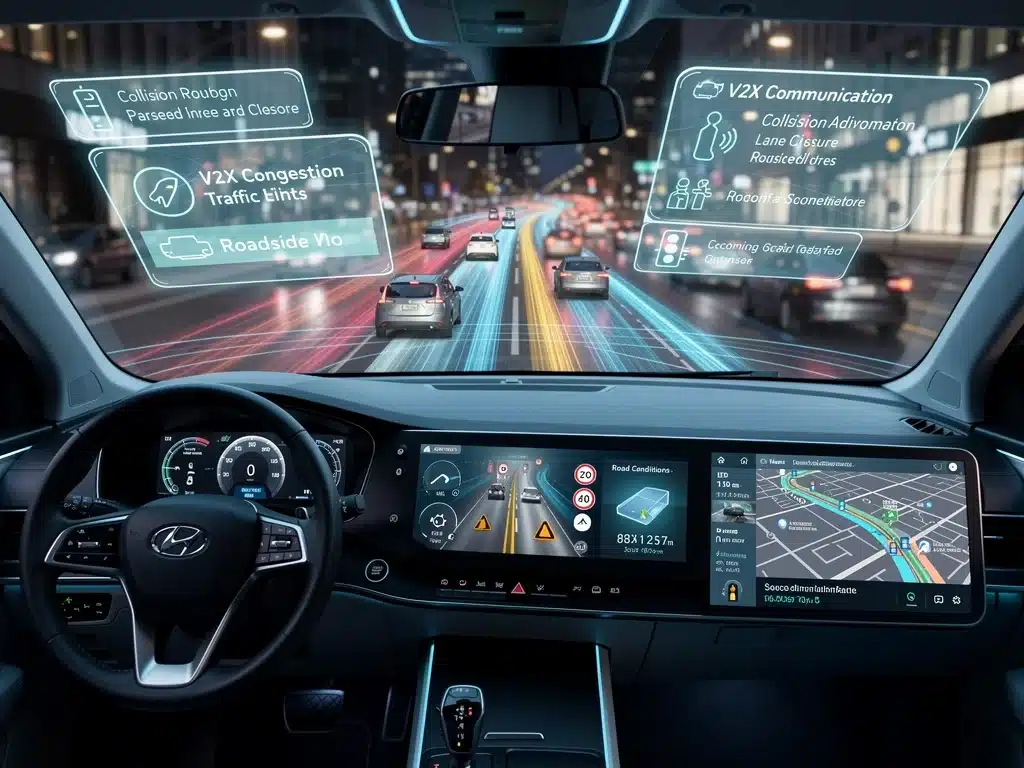
While autonomous vehicles are equipped with advanced sensors (Lidar, radar, cameras), V2X provides a critical layer of information that these sensors cannot replicate. It allows autonomous vehicles to ‘see’ around corners, through obstacles, and beyond the line of sight, providing crucial data that enhances their decision-making capabilities.
- Enhanced situational awareness: Autonomous vehicles receive warnings about distant traffic jams, road hazards, or emergency vehicles they haven’t yet detected with their onboard sensors.
- Coordinated maneuvers: Vehicles can coordinate their movements at intersections or during lane changes, improving efficiency and safety without human intervention.
- Predictive capabilities: Access to real-time infrastructure data allows autonomous vehicles to anticipate traffic signal changes and optimize their speed accordingly.
Integrating V2X into smart city infrastructure
For smart cities, V2X is a cornerstone technology that connects transportation with other urban systems. Beyond traffic management, V2X data can inform urban planning, emergency response, and even public health initiatives. Imagine a city where traffic flow is dynamically adjusted not just for congestion but also to facilitate rapid ambulance passage or to divert vehicles away from areas with poor air quality.
By 2026 and beyond, smart cities will leverage V2X to create a truly interconnected urban environment, where data from vehicles, infrastructure, and citizens contributes to a more responsive, efficient, and livable metropolis. This holistic approach to urban management, powered by V2X, will usher in an era of unprecedented urban intelligence and efficiency. The ongoing integration of V2X will pave the way for a future where urban mobility is not just about moving people and goods, but about creating an intelligent, responsive, and sustainable urban ecosystem.
| Key Aspect | Impact by 2026 |
|---|---|
| Traffic Flow Optimization | Significant reduction in congestion through intelligent signal timing and dynamic routing. |
| Enhanced Road Safety | Dramatic decrease in accidents via real-time collision warnings and hazard alerts. |
| Environmental Benefits | Lower fuel consumption and reduced emissions from smoother, more efficient driving. |
| Autonomous Vehicle Enablement | Crucial for advanced autonomous driving capabilities and smart city integration. |
Frequently asked questions about V2X traffic impact
V2X (Vehicle-to-Everything) communication allows vehicles to exchange data with other vehicles, infrastructure, and pedestrians. It improves traffic flow by enabling intelligent traffic signal management, dynamic routing, and real-time congestion warnings, leading to smoother, more efficient movement and reduced delays across the network.
By 2026, V2X will significantly enhance road safety through predictive collision warnings, blind spot alerts, and real-time hazard notifications. Vehicles will communicate potential dangers, allowing drivers or autonomous systems to react proactively, thereby drastically reducing the likelihood of accidents and improving overall road awareness for all users.
V2X technology offers substantial environmental benefits by promoting smoother traffic flow and reducing congestion. This leads to less stop-and-go driving, which in turn decreases fuel consumption and lowers harmful vehicle emissions. The optimization of routes and speeds contributes to improved air quality and a more sustainable transportation system.
Key challenges for V2X implementation in the U.S. include establishing universal communication standards for interoperability between different systems, securing adequate radio spectrum, ensuring robust data security against cyber threats, and overcoming the significant financial and logistical hurdles of deploying extensive roadside infrastructure. Public acceptance and clear regulatory frameworks are also crucial.
V2X is foundational for autonomous vehicles by providing them with critical information beyond their onboard sensors’ line of sight. This allows autonomous cars to anticipate hazards, coordinate movements with other vehicles and infrastructure, and make more informed decisions, pushing them closer to full autonomy and safer, more efficient operation within complex traffic environments.
Conclusion
The journey towards widespread Vehicle-to-Everything (V2X) communication: understanding its impact on traffic flow by 2026 is well underway, promising a future where our roads are not only safer but also significantly more efficient. As we’ve explored, V2X technology, encompassing various communication modalities, stands to revolutionize traffic management, drastically reduce accidents, and contribute to a healthier environment through lower emissions. While challenges in standardization, regulation, and public adoption remain, the undeniable benefits position V2X as a cornerstone of future smart cities and the enabler of truly autonomous driving. By 2026, we can expect to see tangible shifts in how traffic flows, marking a pivotal moment in the evolution of automotive technology and urban mobility. The collaborative intelligence fostered by V2X will ultimately create a transportation system that is more responsive, sustainable, and enjoyable for everyone.